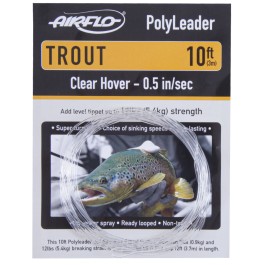
Photos: Airflo · supplied retailer imagery
Fly fishing · Polyleaders · Our take
Airflo 10ft Trout Polyleader
10ft Trout — seven density options
A tapered fly leader with seven density options, welded loops and a 12lb core. Dead handy for adjusting your trout setup — provided you pick the right version and keep the tippet sensible.
- 10ft tapered trout polyleader.
- 12lb core; suitable for tippet up to 12lb breaking strain.
- Supports tippet lengths up to 16ft.
- Welded loops and seven densities, from floating to 7 inches per second.
Make sure it’s the right one. This is the 10ft Trout Polyleader range. Floating and sinking versions are separate choices, not settings on one leader.
Tackle Index Score
Tackle Index score
A useful, adaptable trout leader range whose main strengths are density choice, tapered presentation and straightforward changes.
- Product Quality8.8/10
- Performance9/10
- Impact on Fish Catching8.5/10
- Ease of Use8.9/10
- Value for Money8.6/10
If you buy through our links, we might get a small kickback, but it won’t cost you a penny extra. As an Amazon Associate I earn from qualifying purchases. The full story
Who it suits
Is it right for you?
Great for
- Stillwater trout anglers adjusting depth. Different densities let you alter the front end as fish move up or down, without immediately changing the main fly line.
- Fly anglers who like a modular setup. Loop connections make it straightforward to swap leaders and tailor the tippet to the fly and conditions.
Maybe skip if
- Anglers on tight, overgrown streams. A 10ft leader before you've added tippet can be more length than the swim comfortably allows.
- Anglers needing sustained deep-water coverage. Sinking the front end alone won't always give the depth control or line angle of a suitable full sinking line.
The lowdown
Introducing the Airflo 10ft Trout Polyleader
A tapered fly leader with seven density options, welded loops and a 12lb core. Dead handy for adjusting your trout setup — provided you pick the right version and keep the tippet sensible.
- 10ft tapered trout polyleader.
- 12lb core; suitable for tippet up to 12lb breaking strain.
- Supports tippet lengths up to 16ft.
- Welded loops and seven densities, from floating to 7 inches per second.
Quick verdict
A handy way to broaden your trout setup
The Airflo 10ft Trout Polyleader makes good sense if you want more control over presentation and fishing depth without swapping your whole fly line. The taper and welded loops keep things practical rather than fiddly.
Choose the density for the job, though. A floating version and a fast-sinking version do very different things, and neither excuses an overlong tippet or an awkward casting setup.
A useful, adaptable trout leader range whose main strengths are density choice, tapered presentation and straightforward changes.
- Product Quality
- 8.8/10
- Performance
- 9/10
- Impact on Fish Catching
- 8.5/10
- Ease of Use
- 8.9/10
- Value for Money
- 8.6/10
The tapered design, welded loops and clearly defined core strength make a well-considered trout leader package.
Seven densities give useful presentation options when matched sensibly to the fly line, tippet and fly.
Better control of the front end can help put flies at a useful level, but fish location and presentation still decide plenty.
Loop connections simplify changes, although long tippets and faster-sinking versions need thoughtful handling.
Buying a density that fills a real gap adds useful versatility without requiring another complete fly line.
Head to head
How it stacks up
Side by side with the closest kit we've reviewed. This updates as we add more reviews.
Top scorer
Scores are our own, out of 10. Best in each row is in green. Prices change, so check the latest before you buy.
The full rundown
Everything you'll want to know about the Airflo 10ft Trout Polyleader
The Airflo 10ft Trout Polyleader is one of those bits of fly tackle that earns its place by giving you options. It sits between your fly line and tippet, adding a tapered section that helps carry the cast towards the fly. Depending on the version you choose, it can float, hover or sink at different rates. The big attraction is simple: you can change what the front of your setup does without immediately changing the whole fly line. Less reel-side faff, more attention on where the trout actually are.
First things first, mate: this is a range of seven densities, not one leader that somehow does everything. Clear Floating stays on top, Clear Hover has a stated sink rate of 0.5 inches per second, and Clear Intermediate is rated at 1.5. Then come Slow Sink at 2, Fast Sink at 3, Super Fast Sink at 5 and Extra Fast Sink at 7 inches per second. Those names matter when you're buying. Pick by the job you've got in mind, rather than assuming the quickest sinker must be the most useful.
That choice is particularly handy on stillwaters, where trout can make you look daft by feeding at a completely different level halfway through the day. A shallow presentation might be spot on early, then feel all wrong once conditions shift. Changing polyleader density gives you another adjustment alongside countdown, retrieve speed and fly weight. It doesn't mean you can forget those other bits. A brisk retrieve can lift the presentation, while a weighted fly changes how the business end behaves. You're building a working combination, not just clipping on a depth guarantee.
The 10ft length gives you a substantial tapered section before you add any tippet. That taper is there to help turnover and presentation, smoothing the transition from the fly line towards the lighter material beyond it. It's useful support, but it won't rescue every casting mismatch. A bulky fly, awkward wind and far too much fine tippet can still leave everything landing in a heap. Keep the setup balanced and let the cast straighten properly. There’s no prize for making the leader as long or complicated as possible.
Airflo gives this Trout version a 12lb core and says it's suitable for tippet up to 12lb breaking strain. That's a ceiling for the tippet choice, not an instruction to fish heavy material all day. Match your tippet to the fly size, likely fish and conditions instead. Small flies generally need a different approach from a chunky lure. Check knots and look for damage after snags or a scrap, too. A strong core doesn't make the rest of the connection immune to wear, poor knots or a nicked length of tippet.
The supported tippet length reaches up to 16ft, which offers plenty of scope when a longer presentation makes sense. Don't read that as the default setup, though. Add the full amount to the polyleader and you've got a long stretch beyond the fly line to manage. That's more demanding to cast, and potentially awkward when bringing a fish close enough to net. On a breezy bank or with limited room behind you, a more manageable tippet can be the sensible move. Good presentation beats chasing the biggest possible number.
Welded loops are a practical part of the appeal. With a compatible looped fly line, changing the leader is straightforward, which encourages useful adjustments rather than sticking with the wrong setup because swapping feels like a chore. Keep different densities clearly identified when you put them away. Fishing the wrong one because everything was bundled into the same pocket is avoidable faff. Before casting, check that the loop connection is seated neatly and inspect the leader for damage. Little habits like that help keep the whole arrangement tidy and dependable.
So, who should be looking at it? Mainly trout anglers who want a flexible front end and understand that depth control comes from the whole setup. It's a sensible option for exploring different presentations without treating every change as a reason to swap spools. It makes less sense if your fishing is all cramped little streams, or if you need a full sinking line to work deeper water properly. Choose a density that fills a genuine gap in your fishing, keep the tippet practical, and this is a useful bit of kit rather than another pocket-filler.
Specifications
The nuts and bolts
- Length
- 10ft
- Core strength
- 12lb
- Maximum suitable tippet strength
- 12lb breaking strain
- Supported tippet length
- Up to 16ft
- Design
- Tapered polyleader with welded loops
- Density options and stated sink rates
- Clear Floating: 0; Clear Hover: 0.5; Clear Intermediate: 1.5; Slow Sink: 2; Fast Sink: 3; Super Fast Sink: 5; Extra Fast Sink: 7 inches per second
Specs checked with Airflo, Oct 2026.
Spot a model or spec change?
Our take
Sort the front end, not the whole reel
The appeal is changing how the front of your setup behaves while keeping the same main fly line. That's useful when trout move through the water column and yesterday's cracking approach suddenly feels miles off.
Think of it as a presentation tool, not a guaranteed route to a take. Density, tippet length, fly weight and retrieve all need to work together.
The setup
Closer look: a tapered link with a clear job
You're buying a 10ft polyleader in a chosen density, with a 12lb core and welded loops. It bridges the fly line and your added tippet. The tapered design helps carry energy through the cast; the density determines whether that section floats or sinks, and how quickly it's intended to sink.
Don't confuse core strength with the strength of your finished setup. Your tippet, knots and their condition still govern what you can safely lean on. Equally, the ability to support up to 16ft of tippet doesn't mean every fly or casting situation suits that length.
Worth knowing. Stated sink rates aren't a stopwatch-to-depth promise for your fly. Current, retrieve, fly weight, tippet and the main fly line all affect where the finished setup fishes.
On the water
Who it suits: anglers who like useful adjustments
Stillwater trout anglers have an obvious use for this range. A floating line paired with a suitable sinking polyleader can help work the fly beneath the surface while leaving the main line floating. It's a handy change of approach, rather than a claim that one spool now covers every depth.
It also suits anglers who prefer making one change at a time. Keep the fly and retrieve broadly consistent, change density, and pay attention to what happens. That gives your adjustments some purpose instead of changing everything at once and wondering which bit made the difference.
For tiny streams, cramped casting spots or consistently deep fishing, look carefully at the alternatives. A shorter leader may be easier in tight quarters, while a suitable sinking fly line can offer a more useful overall fishing angle at depth. Buy for your water, not just for the impressive list of options.
Quick answers
FAQs in full: density, strength and tippet length
Which density should you buy? Start with the presentation you're missing. Clear Floating suits keeping the leader on the surface. Clear Hover and Clear Intermediate offer slower subsurface options. The four faster-sinking choices give progressively quicker descent. Faster isn't automatically better, particularly over shallow bottoms or weed.
How strong should the tippet be? No more than the stated 12lb suitable maximum, and often lighter depending on your fishing. Consider fly size, fish and obstacles rather than matching the core just because you can. Check the tippet and connections regularly, especially after contact with rough bankside cover or submerged snags.
How much tippet should you add? Up to 16ft is supported, but use a length you can turn over and handle comfortably. On sinking versions, tippet length also influences how closely the fly follows the sinking leader. Shortening it can help keep that relationship more direct; fly buoyancy and weight still play their part.
On paper
Pros & cons
What we like
- Seven density choices cover surface work through to faster-sinking presentations.
- Tapered design helps transfer casting energy towards the fly.
- Welded loops make leader changes straightforward with a compatible looped fly line.
- Allows useful depth adjustments without changing the entire fly line.
Worth knowing
- Different densities require separate leaders.
- The 10ft body plus tippet can feel cumbersome on cramped banks.
- A sinking leader doesn't replace a full sinking line for every deep-water job.
Want one?
Add it to your Wanted list or join a Group Buy — shops see anonymous totals only.
Your questions answered
What anglers want to know
The stuff you’d ask your mate on the next peg. Straight answers, no waffle.
01Is the 12lb core a reason to use 12lb tippet?
Is the 12lb core a reason to use 12lb tippet?
No. It supports tippet up to 12lb, but choose your actual tippet for the fly, fish and conditions. Lighter tippet is fine where appropriate; sound knots and regular checks still matter.
02Which density should I choose?
Which density should I choose?
Floating suits surface-led presentations, hover and intermediate options cover shallow subsurface work, and the sinking versions help pull the front end deeper. Choose around the depth and retrieve you need, rather than automatically buying the fastest.
03Do I have to add 16ft of tippet?
Do I have to add 16ft of tippet?
Not at all. That's the supported upper length, not a recommendation for every session. Start with a manageable length suited to your fly and method, then adjust if presentation calls for it.
What anglers say
The word from the bank
Our read: a handy way to broaden your trout setup. The strongest reasons to choose it are seven density choices cover surface work through to faster-sinking presentations. and tapered design helps transfer casting energy towards the fly.; the main trade-off is different densities require separate leaders..
Our take on the feedback
Why it appeals
Checked Sept '26 — “Seven density choices cover surface work through to faster-sinking presentations.”
Best fit
Checked Sept '26 — “Stillwater trout anglers adjusting depth: Different densities let you alter the front end as fish move up or down, without immediately changing the main fly line.”
Worth knowing
Checked Sept '26 — “Different densities require separate leaders.”
Tackle Index’s take from the product details and fishing fit we checked. We haven’t found enough independent public feedback to call this an angler consensus yet.
Angler score
What our readers rate Airflo 10ft Trout Polyleader
No angler score yet — nobody's reviewed Airflo 10ft Trout Polyleader here. Be the first and get the score started.
Owner reports
Own this? Help the next angler.
Quick multiple-choice reports from people who say they own the Airflo 10ft Trout Polyleader. Not verified purchases, and kept separate from our score.
No owner reports yet.
Alternatives & go-withs