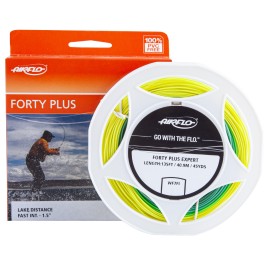
Photos: Airflo · supplied retailer imagery
Fly fishing · Distance fly lines · Our take
Airflo Forty Plus Expert Fly Line
Forty Plus Expert range; WF7 and WF8 Di3, Di5 and Di7 options
A 45-foot head, Power Core construction and Ridge running line give this distance-minded fly line plenty of appeal for reservoir anglers. Just don’t mistake it for a shortcut to tidy casting.
- 45-foot head.
- Power Core construction.
- Ridge running line.
- WF7 and WF8 options listed in Di3, Di5 and Di7.
Make sure it’s the right one. This is the Forty Plus Expert, not a blanket review of every Forty Plus line. The Original version uses a shooting head joined to the running line by a sleeved link; check which version you’re buying.
Tackle Index Score
Tackle Index score
A strong specialist option for competent reservoir anglers, with its appeal tied closely to casting ability and choosing the right sinking grade.
- Product Quality8.8/10
- Performance9/10
- Impact on Fish Catching8.5/10
- Ease of Use7.7/10
- Value for Money8.3/10
If you buy through our links, we might get a small kickback, but it won’t cost you a penny extra. As an Amazon Associate I earn from qualifying purchases. The full story
Who it suits
Is it right for you?
Great for
- Confident reservoir bank anglers. The distance-focused layout suits covering water beyond your comfortable short-range fishing, provided there’s room to cast.
- Boat anglers fishing subsurface. Different sinking grades give you useful choices for working flies through deeper water and adjusting to the drift.
Maybe skip if
- New fly anglers still sorting their timing. A more forgiving, general-purpose line is usually a simpler starting point than managing a 45-foot head.
- Small-water and dry-fly specialists. The distance emphasis may be unnecessary, while these sinking options don’t replace a floating line.
The lowdown
Introducing the Airflo Forty Plus Expert Fly Line
A 45-foot head, Power Core construction and Ridge running line give this distance-minded fly line plenty of appeal for reservoir anglers. Just don’t mistake it for a shortcut to tidy casting.
- 45-foot head.
- Power Core construction.
- Ridge running line.
- WF7 and WF8 options listed in Di3, Di5 and Di7.
Quick verdict
Proper reservoir tackle, with a learning curve
The Forty Plus Expert makes sense if you already cast confidently and want a distance-focused sinking line for bigger water. Its 45-foot head gives you a substantial working length, backed by Power Core construction and Ridge running line.
It’s less convincing for beginners, cramped banks or anglers mostly fishing close in. Choose the sink grade around your fishing rather than chasing the fastest option, and this is a nicely focused bit of kit.
A strong specialist option for competent reservoir anglers, with its appeal tied closely to casting ability and choosing the right sinking grade.
- Product Quality
- 8.8/10
- Performance
- 9/10
- Impact on Fish Catching
- 8.5/10
- Ease of Use
- 7.7/10
- Value for Money
- 8.3/10
Power Core construction and Ridge running line give it a purposeful feature set for its intended fishing.
The distance-focused layout offers capable casters useful scope for covering bigger water.
Reach and a suitable sinking grade can improve access to fish, but depth control and presentation remain decisive.
Managing the 45-foot head and loose running line asks more of the angler than a compact general-purpose setup.
Its specialist features offer useful value for regular reservoir fishing but less benefit if most of your fishing is close in.
Head to head
How it stacks up
Side by side with the closest kit we've reviewed. This updates as we add more reviews.
Airflo
Airflo Forty Plus Expert Fly Line (this one)
Top scorer
Scores are our own, out of 10. Best in each row is in green. Prices change, so check the latest before you buy.
The full rundown
Everything you'll want to know about the Airflo Forty Plus Expert Fly Line
The Airflo Forty Plus Expert is for those days when a reservoir looks enormous and the trout seem determined to use every inch of it. It’s a distance-minded fly line, with a 45-foot head, Power Core construction and Ridge running line. That’s a purposeful combination for anglers who want to cover more water with sinking flies. But the important word on the box is Expert. This isn’t a magic bit of string that turns a rushed backcast into a lovely, straight delivery. You still need timing, space and sensible line management.
That 45-foot head is the starting point. Compared with a compact head, there’s more length to manage as you build the cast, so control matters. Let the backcast straighten, keep your tracking tidy and don’t assume another furious false cast will sort everything out. A capable caster can work with that longer head before releasing running line to shoot. If you’re still fighting tailing loops, though, it can become a bit of a faff. There’s no shame in choosing a shorter, more forgiving design while you get the basics bob on.
The running line deserves attention too, because a distance cast can fall apart before it’s properly left your hand. Airflo’s Ridge running line is part of the Expert’s shooting setup, but it still needs a clear path. Loose coils around boots, bank vegetation or boat fittings won’t politely untangle themselves when you let go. From the bank, a suitable line tray can be dead handy. In a boat, sort your working area before you start. Those dull little jobs often make more difference to usable distance than trying to punch the rod harder.
Power Core construction brings the other side of the job into focus: fishing the line once it lands. Its low-stretch approach is aimed at keeping contact more direct, which matters when you’re retrieving flies a fair way out. Don’t read that as a promise that every gentle pluck becomes a hooked trout. Slack still gets in the way, especially with a crosswind or an awkward angle between rod tip and line. Keep the tip sensibly positioned during the retrieve and stay in touch. The core can help; it can’t tidy loose line for you.
For the sinking options, there are WF7 and WF8 versions listed in Di3, Di5 and Di7. That choice is proper useful on reservoirs, where the productive layer can change with weather, light and the way you’re fishing. Di3 is the slower-sinking option of those three, with Di5 in the middle and Di7 the fastest. Faster doesn’t automatically mean better. A steep bank, deep water and a brisk retrieve ask different questions from a shallow shelf and flies you want to work slowly. Pick the tool for the swim, not the biggest number.
A repeatable countdown is a better starting point than chucking out and guessing. Let the line settle for a chosen count, retrieve at a reasonably consistent pace and adjust one thing at a time. If you get interest, you’ve got something you can repeat. Remember that countdown isn’t a depth gauge: fly weight, wind, drift and retrieve speed all affect where the flies actually travel. From a drifting boat, that picture keeps changing as you move. On the bank, watch shallowing water near your feet before dragging a fast-sinking setup straight into trouble.
There’s also a buying detail that’s easy to miss. The Original Forty Plus Expert uses a shooting head joined to the running line with a sleeved link. That’s worth checking on the actual version being offered, rather than assuming every line wearing the Forty Plus name is built identically. On an Original, pay attention to the condition of that connection as part of your normal tackle checks. Match the listed line size to a suitable rod as well; don’t automatically jump a size because you reckon heavier must mean further. A balanced outfit is a much better starting point.
So, who should be interested? Mainly the reservoir angler who already casts reasonably well and wants a focused sinking-line option for covering water. There’s a clear job here from an open bank or a boat, particularly when reaching fish and controlling depth need to work together. It’s much less compelling for tiny waters, overgrown backcasts or an afternoon spent presenting dries. Extra yards are lovely when they put your flies in front of feeding trout. When the fish are close, though, keep it simple, mate. Fish the useful water first, not the furthest water you can reach.
Specifications
The nuts and bolts
- Line type
- Distance-focused weight-forward fly line
- Head length
- 45 feet
- Core
- Power Core
- Running line
- Ridge
- Listed sinking options
- WF7 and WF8 in Di3, Di5 and Di7
- Original version connection
- Shooting head joined to running line by a sleeved link
Specs checked with Airflo, Oct 2026.
Spot a model or spec change?
Our take
The useful bit isn’t just the extra yards
Distance only helps when your flies reach the right water and fish at the right depth. The choice of Di3, Di5 and Di7 versions is at least as important as the line’s casting ambition.
Think of this as a line for extending an already sound reservoir approach, not rescuing a scruffy cast. Good line management, a suitable rod and room behind you still do the heavy lifting.
Design and setup
A longer head with a clear job
The main ingredients are straightforward: a 45-foot head, Power Core construction and Ridge running line. Together, they make this a distance-focused choice rather than a general-purpose recommendation for every fly outfit. The longer head rewards controlled casting; the running line needs clean, untangled coils if you want the shoot to do its job.
Choose the sinking grade before getting carried away with casting range. Di3, Di5 and Di7 give you progressively faster-sinking choices, with WF7 and WF8 options listed. Think about the depth you normally fish, your retrieve and whether you’re standing still or drifting. One line won’t cover every combination equally well.
Worth knowing. The Original version has a sleeved link between the shooting head and running line. Check the exact version and inspect that connection during routine line care, especially when buying an older example.
Picking your outfit
Best when your casting already feels tidy
Open-bank reservoir anglers are the obvious audience. If you can already form consistent loops and manage your running line, the Expert gives you a purposeful setup for exploring more water. It can also suit boat work with sinking flies, where choosing the right sink grade helps you stay closer to the productive layer.
If your usual backcast finishes in a bush, this probably isn’t the cleverest purchase. Likewise, beginners may get more useful fishing from a forgiving all-round line. For dry flies, use a suitable floater instead of trying to make one of these sinking versions cover a job it isn’t meant for.
Before you buy
The practical questions, without the waffle
Is 45 feet the whole line? No, it’s the head length. It describes the working head, not total reach or a guaranteed casting distance. You also don’t have to carry the entire head outside the tip for every delivery; adjust your cast to the distance you actually need.
Which sink grade should you get? Start with your normal fishing. Di3 gives you more settling time than Di7, while Di5 sits between them. Faster-sinking lines can help when you need to reach deeper water, but can be awkward over shallow bottoms or with very slow retrieves. Keep countdown and retrieve consistent while you search.
Does every version have the sleeved link? That connection is a confirmed feature of the Original Forty Plus Expert. Don’t extend that detail to the whole Forty Plus family. Check the exact model description, then choose the line rating around your rod’s recommended loading rather than treating extra weight as free distance.
On paper
Pros & cons
What we like
- Distance-focused design suits covering bigger reservoir water.
- 45-foot head offers confident casters a substantial working length.
- Power Core construction favours direct contact during the retrieve.
- Choice of sinking grades helps you target different depths.
Worth knowing
- Long head asks more of your casting and backcast space than a compact alternative.
- Sinking versions aren’t an all-round answer for surface fishing.
- Original version’s sleeved connection is another detail to inspect and maintain.
Want one?
Add it to your Wanted list or join a Group Buy — shops see anonymous totals only.
Your questions answered
What anglers want to know
The stuff you’d ask your mate on the next peg. Straight answers, no waffle.
01How long is the Forty Plus Expert head?
How long is the Forty Plus Expert head?
The head is 45 feet long. That’s the head length, not the total line length, and you don’t need to carry all of it outside the rod tip on every cast.
02Should I choose Di3, Di5 or Di7?
Should I choose Di3, Di5 or Di7?
Di3 is the slower-sinking choice of these three, Di5 sits between them and Di7 sinks fastest. Choose around depth, retrieve speed and drift; none guarantees a fixed fishing depth.
03Does it have a sleeved head connection?
Does it have a sleeved head connection?
The Original Forty Plus Expert has a shooting head joined to the running line with a sleeved link. Check the version you’re buying rather than assuming every Forty Plus shares that construction.
What anglers say
The word from the bank
Our read: proper reservoir tackle, with a learning curve. The strongest reasons to choose it are distance-focused design suits covering bigger reservoir water. and 45-foot head offers confident casters a substantial working length.; the main trade-off is long head asks more of your casting and backcast space than a compact alternative..
Our take on the feedback
Why it appeals
Checked Sept '26 — “Distance-focused design suits covering bigger reservoir water.”
Best fit
Checked Sept '26 — “Confident reservoir bank anglers: The distance-focused layout suits covering water beyond your comfortable short-range fishing, provided there’s room to cast.”
Worth knowing
Checked Sept '26 — “Long head asks more of your casting and backcast space than a compact alternative.”
Tackle Index’s take from the product details and fishing fit we checked. We haven’t found enough independent public feedback to call this an angler consensus yet.
Angler score
What our readers rate Airflo Forty Plus Expert Fly Line
No angler score yet — nobody's reviewed Airflo Forty Plus Expert Fly Line here. Be the first and get the score started.
Owner reports
Own this? Help the next angler.
Quick multiple-choice reports from people who say they own the Airflo Forty Plus Expert Fly Line. Not verified purchases, and kept separate from our score.
No owner reports yet.
Alternatives & go-withs