Photos: Airflo · supplied retailer imagery
Fly fishing · Sinking fly lines · Our take
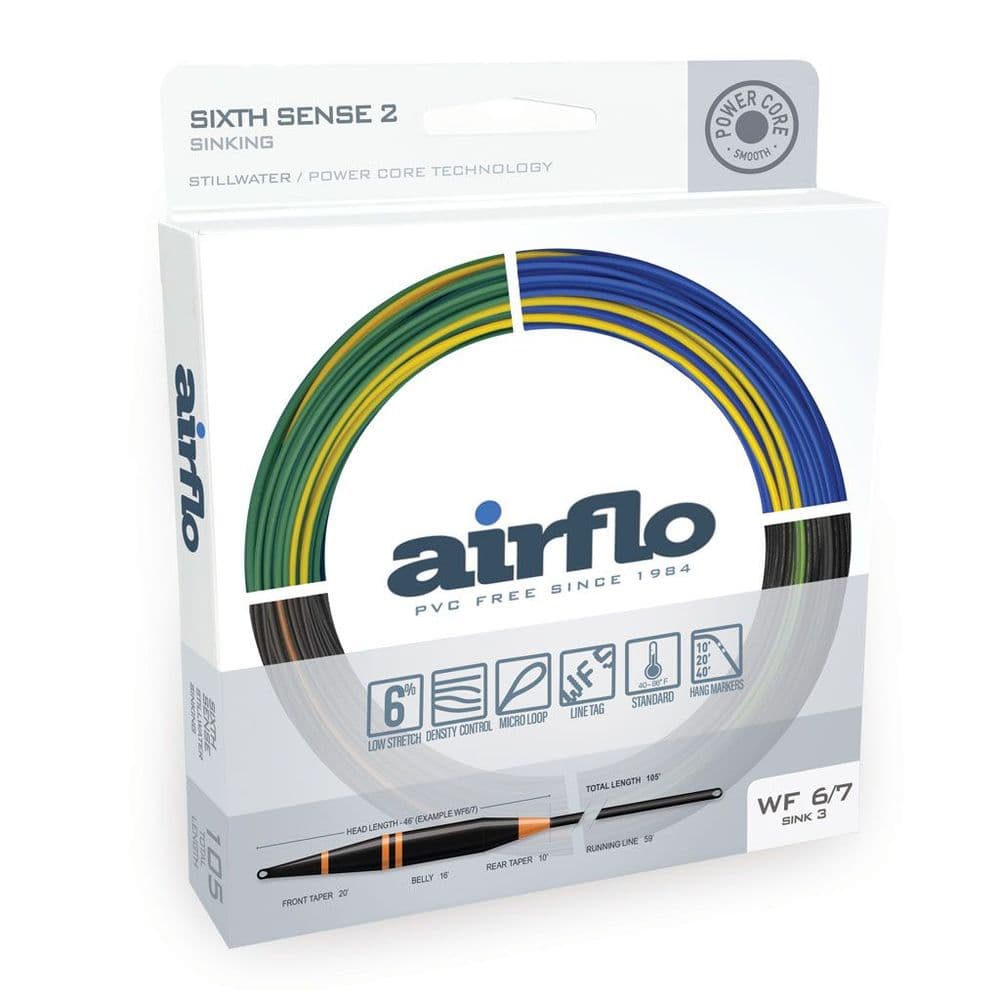
Airflo Sixth Sense 2 Sinking Fly Line
Sixth Sense 2 sinking range: Di3, Di5, Di7 and Di8
A stillwater sinker with a low-stretch core, a long front taper and a handy hang mark. Pick the right density and it gives your flies a proper chance of reaching feeding trout.
- 105ft / 32m total length with a 46ft / 14.02m head.
- Low-stretch construction built around a 20lb braid core.
- Long front taper and built-in hang mark.
- Di3, Di5, Di7 and Di8 versions have nominal sink rates of 3, 5, 7 and 8 inches per second.
Make sure it’s the right one. This is the sinking Sixth Sense 2 fly-line range, not a floating line or conventional carp and coarse mainline. Available line weights vary by sink rate.
Tackle Index Score
Tackle Index score
A well-considered stillwater sinking range whose strongest benefits are depth choice and contact. Value depends on choosing a density you'll actually use.
- Product Quality8.8/10
- Performance9/10
- Impact on Fish Catching8.6/10
- Ease of Use8.3/10
- Value for Money8.5/10
If you buy through our links, we might get a small kickback, but it won’t cost you a penny extra. As an Amazon Associate I earn from qualifying purchases. The full story
Who it suits
Is it right for you?
Great for
- Reservoir and stillwater trout anglers. The density choices suit searching different layers with wets, lures and other subsurface presentations.
- Anglers building a purposeful spare-spool selection. Each sinking version can fill a specific gap rather than trying to make one line do every job.
Maybe skip if
- Dry-fly anglers wanting one everyday line. A sinking line isn't the right starting point for keeping dry flies fishing neatly on top.
- Beginners mostly fishing shallow, weedy pools. Depth management and lifting a submerged line add faff, especially with the faster densities.
The lowdown
Introducing the Airflo Sixth Sense 2 Sinking Fly Line
A stillwater sinker with a low-stretch core, a long front taper and a handy hang mark. Pick the right density and it gives your flies a proper chance of reaching feeding trout.
- 105ft / 32m total length with a 46ft / 14.02m head.
- Low-stretch construction built around a 20lb braid core.
- Long front taper and built-in hang mark.
- Di3, Di5, Di7 and Di8 versions have nominal sink rates of 3, 5, 7 and 8 inches per second.
Quick verdict
A proper tool for fishing below the surface
The Sixth Sense 2 makes plenty of sense for stillwater trout anglers who want deliberate depth control rather than another hopeful cast. The low-stretch core and built-in hang mark are useful touches, while four sinking densities cover distinctly different jobs.
The catch? You need to choose the right version. A Di8 isn't a better Di3; it's a faster-sinking tool. Match the density to your water and retrieve, and this is a cracking addition to a dedicated stillwater outfit.
A well-considered stillwater sinking range whose strongest benefits are depth choice and contact. Value depends on choosing a density you'll actually use.
- Product Quality
- 8.8/10
- Performance
- 9/10
- Impact on Fish Catching
- 8.6/10
- Ease of Use
- 8.3/10
- Value for Money
- 8.5/10
The low-stretch braid core, long front taper and built-in marker make a purposeful feature package.
Four sinking densities offer useful presentation choices when matched to depth, drift and retrieve.
Reaching the feeding layer can make a real difference, but density alone won't find or fool trout.
The hang mark helps repeatability, though managing a submerged line takes more care than fishing a floater.
It offers useful features for regular stillwater fishing, with less benefit if your chosen density rarely leaves the bag.
Head to head
How it stacks up
Side by side with the closest kit we've reviewed. This updates as we add more reviews.
Airflo
Airflo Sixth Sense 2 Sinking Fly Line (this one)
Top scorer
Scores are our own, out of 10. Best in each row is in green. Prices change, so check the latest before you buy.
The full rundown
Everything you'll want to know about the Airflo Sixth Sense 2 Sinking Fly Line
When the trout have stopped showing, chucking the same floating line into the same patch can become a proper exercise in optimism. The Airflo Sixth Sense 2 Sinking Fly Line gives you a different way into that problem: put the line below the surface and manage where your flies travel. It's aimed squarely at subsurface fly fishing, particularly on stillwaters and reservoirs. This isn't carp mainline with a fancy name, mate. It's a casting line whose sinking behaviour is part of the presentation, alongside your leader, fly choice and retrieve.
The first buying decision is density, not colour. You've got Di3, Di5, Di7 and Di8 versions, with nominal sink rates of three, five, seven and eight inches per second respectively. That sounds straightforward, and it is a useful starting point. But don't turn those figures into a promise that your flies will sit at an exact depth after a particular countdown. Wind, drift, leader construction and the flies themselves all complicate things. The useful bit is repeatability: count down, retrieve, then change one thing rather than giving everything a random tweak.
For less aggressive sinking duties, the Di3 gives you more breathing room before the line reaches weed or bottom. That's handy when you're exploring shallower water or want a slower retrieve without immediately dragging through the greenery. Step up to Di5 and you've got a faster route below the surface. Di7 and Di8 are more specialised choices for getting down quickly or helping keep a presentation deeper during a brisk retrieve. None is the automatic winner. Buying the fastest because it sounds the most serious is an easy way to collect weed.
Airflo gives this range a 46ft head within an overall length of 105ft, plus a long front taper. The taper points towards a progressive delivery rather than a blunt, all-at-once turnover. There's a useful amount of head to work with, but you still need a casting stroke and space that suit it. On a cramped bank, don't assume a longer cast is the answer to everything. Fish the water you can cover cleanly, keep the running line clear of your boots and vegetation, and let the sinking density do its job.
The low-stretch construction is another sensible feature for this sort of fishing. With a long length of line between you and the flies, reduced stretch helps preserve contact when something plucks at the business end. That doesn't mean every little knock becomes a hooked trout. A belly in the line still dulls communication, and slack is still slack. Keep your retrieve organised and stay ready to respond through the line rather than throwing in an enormous rod lift. The 20lb braid core is a construction detail, not an instruction to fish a matching leader.
Then there's the built-in hang mark, which is dead handy if you're trying to make the last part of the retrieve more deliberate. From a boat especially, a pause and controlled lift can keep your flies fishing instead of whisking them straight out for another cast. The marker gives you a reference you can return to. It doesn't tell you exactly where every fly is, because leader length and line angle change that. Think consistent stopping point, not underwater ruler, and you've got the right idea.
Line-weight choice needs a little attention too. Di3 and Di5 come in WF5/6, WF6/7, WF7/8 and WF8/9, while Di7 and Di8 start at WF6/7 and run through WF8/9. Match your choice to the rod's line recommendation rather than assuming every sinking version is available for every outfit. Once you're fishing, resist trying to lift a deeply submerged line straight into a big back cast. Bring it under control and towards the surface first. It's less faff than wrestling a loaded rod while the flies are still well down.
For a regular stillwater angler, the appeal is having a purposeful tool rather than another mystery spool in the bag. Pick a density that fills a genuine gap, use repeatable countdowns, and pay attention to where takes happen through the retrieve. If most of your fishing is dries over skinny water, this isn't the obvious buy. If trout are feeding beneath the reach of your usual approach, though, the Sixth Sense 2 offers a practical way to explore that water without relying entirely on heavier flies.
Specifications
The nuts and bolts
- Total length
- 105ft / 32m
- Head length
- 46ft / 14.02m
- Core
- 20lb braid; low-stretch construction
- Taper and marker
- Long front taper; built-in hang mark
- Di3 and Di5
- 3 and 5 inches/second respectively; WF5/6, WF6/7, WF7/8 and WF8/9
- Di7 and Di8
- 7 and 8 inches/second respectively; WF6/7, WF7/8 and WF8/9
Specs checked with Airflo, Oct 2026.
Spot a model or spec change?
Our take
Depth first, distance second
The big selling point isn't simply getting a fly farther out. It's being able to repeat a countdown and retrieve once you've found the feeding layer.
Treat the hang mark as a repeatable reference near the end of the retrieve, not a magic depth gauge. Fly weight, leader length, drift and line angle still have their say.
The details
Closer look: a sinker with a clear job
You're buying a complete sinking fly line with a 46ft head, long front taper and low-stretch braid core. Those features serve different purposes: the taper influences delivery, the core helps maintain contact, and the density controls how quickly the line sinks. Don't expect any one of them to rescue a poorly matched outfit.
The colour pairings help distinguish versions: Di3 is Dark Green/Aqua, Di5 Dark Blue/Pale Blue, Di7 Black/Grey and Di8 Black/Purple. If you've got several spools, label them with density and line weight as well. That's much less faff than trying to remember which dark line is which when the boat's drifting.
Worth knowing. Nominal sink rate isn't the same as fly depth during a retrieve. Use it to choose your starting line, then build a repeatable countdown-and-retrieve routine. Once you get a take, remember the count and retrieve speed before changing anything.
Find your fit
Who it suits: anglers ready to work the layers
This range is a natural fit for reservoir anglers carrying interchangeable spools. A slower sinker and a faster one offer genuinely different options when trout shift position. You don't need all four densities straight away; choose the one that solves the problem your current lines leave you with.
Bank anglers can make good use of it too, provided there's enough depth and room. Watch the shallowing water near your feet: a line that fishes nicely farther out can start dragging as it approaches the margins. Shortening the countdown or finishing the retrieve earlier may be more useful than changing flies.
It's less compelling for someone who mostly fishes dry flies or shallow, weed-choked water. Nor does buying a fast sinker guarantee more trout. The gain is access to a different presentation; finding feeding fish and keeping the flies in their path still does the heavy lifting.
Bank-side questions
FAQs in full: picking and fishing it
Which density first? Pick around your normal fishing, not the deepest water you might visit once. Di3 offers a slower descent, Di5 gets down more quickly, and Di7 or Di8 make sense when a rapid descent is genuinely useful. Your retrieve matters too: pulling faster tends to lift the presentation, so a fast sinker isn't exclusively a deep-water tool.
What leader strength should you use? Ignore the temptation to match the 20lb core figure. Leader choice depends on fly size, likely fish, abrasion risks and local rules. Use sound knots and check the tippet after fish or snags. A low-stretch line also makes a forgiving rod and sensible pressure useful when a trout lunges close in.
How should you use the hang mark? Watch for it during the closing part of the retrieve, then use that reference to repeat a pause or controlled lift. Stay in contact and follow fishery rules on methods and flies. The mark helps organise the finish; it doesn't guarantee a last-second take, however tempting that thought might be.
On paper
Pros & cons
What we like
- Four sink rates let you choose a line for a particular depth-and-retrieve job.
- Low-stretch core helps keep contact with flies on longer retrieves.
- Built-in hang mark gives a useful end-of-retrieve reference.
- Long front taper favours a more progressive delivery.
Worth knowing
- One density won't cover every depth or retrieve speed.
- Faster versions can find weed and bottom quickly in shallow water.
- The 46ft head needs casting room and sensible line management.
Want one?
Add it to your Wanted list or join a Group Buy — shops see anonymous totals only.
Your questions answered
What anglers want to know
The stuff you’d ask your mate on the next peg. Straight answers, no waffle.
01Which sink rate should I choose?
Which sink rate should I choose?
Start with your usual depth and retrieve. Di3 gives more time before reaching bottom; Di5 sinks faster, while Di7 and Di8 suit jobs where getting down quickly matters. Faster retrieves lift flies, so water depth alone doesn't decide it.
02Does the 20lb core mean I should use a 20lb leader?
Does the 20lb core mean I should use a 20lb leader?
No. The core figure describes the fly line's braid core, not a leader recommendation. Choose your leader for the flies, trout, conditions and fishery rules.
03What does the built-in hang mark do?
What does the built-in hang mark do?
It provides a visible reference as the line comes back towards you. That helps you repeat where you pause or lift the flies at the end of a retrieve, especially from a boat.
What anglers say
The word from the bank
Our read: a proper tool for fishing below the surface. The strongest reasons to choose it are four sink rates let you choose a line for a particular depth-and-retrieve job. and low-stretch core helps keep contact with flies on longer retrieves.; the main trade-off is one density won't cover every depth or retrieve speed..
Our take on the feedback
Why it appeals
Checked Sept '26 — “Four sink rates let you choose a line for a particular depth-and-retrieve job.”
Best fit
Checked Sept '26 — “Reservoir and stillwater trout anglers: The density choices suit searching different layers with wets, lures and other subsurface presentations.”
Worth knowing
Checked Sept '26 — “One density won't cover every depth or retrieve speed.”
Tackle Index’s take from the product details and fishing fit we checked. We haven’t found enough independent public feedback to call this an angler consensus yet.
Angler score
What our readers rate Airflo Sixth Sense 2 Sinking Fly Line
No angler score yet — nobody's reviewed Airflo Sixth Sense 2 Sinking Fly Line here. Be the first and get the score started.
Owner reports
Own this? Help the next angler.
Quick multiple-choice reports from people who say they own the Airflo Sixth Sense 2 Sinking Fly Line. Not verified purchases, and kept separate from our score.
No owner reports yet.
Alternatives & go-withs