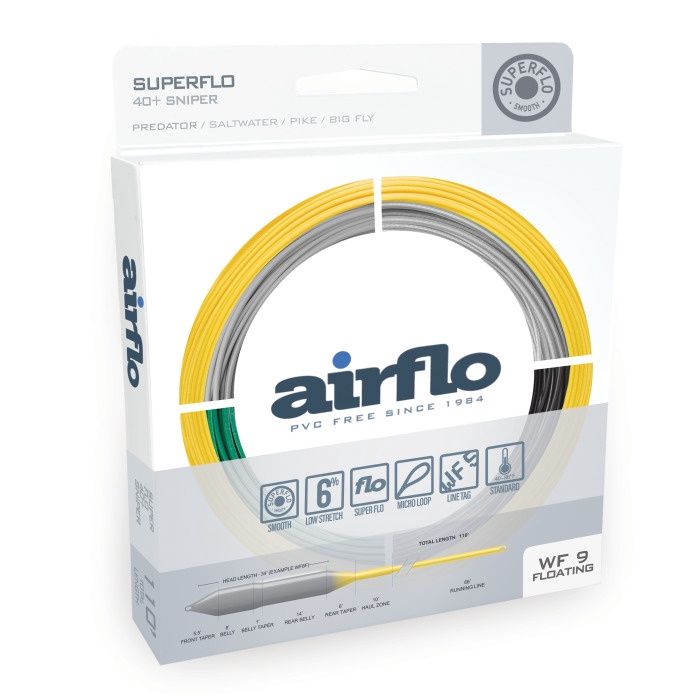
Photos: Airflo · supplied retailer imagery
Fly fishing · Fly lines · Our take
Airflo Sniper Fly Line
Superflo 40+ Sniper · WF8–WF10 · Floating, Fast Intermediate, Di3 and Di7
A short-headed fly line for shifting bulky flies, with floating and sinking options to cover different depths. Just match the head weight to your rod before getting carried away.
- Available in WF8, WF9 and WF10.
- Floating, Fast Intermediate, Di3 and Di7 density options.
- 110 ft / 33.5 m total length with a 30 lb braid core.
- 31 ft heads on Floating and Fast Intermediate; 28 ft / 8.5 m heads on Di3 and Di7.
Make sure it’s the right one. This review covers the Airflo Superflo 40+ Sniper, model ASF-40SN, rather than other Airflo lines carrying the Sniper name.
Tackle Index Score
Tackle Index score
A strong on-paper fit for heavier fly work, with useful density choices and clear head weights. Its appeal depends on a sensible rod match and choosing the right version; value is judged on usefulness rather than an assumed selling price.
- Product Quality8.8/10
- Performance9/10
- Impact on Fish Catching8.6/10
- Ease of Use8.4/10
- Value for Money8.3/10
If you buy through our links, we might get a small kickback, but it won’t cost you a penny extra. As an Amazon Associate I earn from qualifying purchases. The full story
Who it suits
Is it right for you?
Great for
- Anglers casting bulky predator flies. The short, substantial head is a sensible fit for flies that demand more turnover than a delicate presentation taper.
- Fly anglers tackling different feeding depths. The density range lets you choose a line around shallow cover, subsurface retrieves or deeper presentations.
Maybe skip if
- Light-line trout anglers. WF8–WF10 sizes and hefty full head weights are a poor fit for light rods and tiny dries.
- Anyone wanting one line for every depth. Each density is a separate choice, and a floating line cannot simply stand in for a fast sinker.
The lowdown
Introducing the Airflo Sniper Fly Line
A short-headed fly line for shifting bulky flies, with floating and sinking options to cover different depths. Just match the head weight to your rod before getting carried away.
- Available in WF8, WF9 and WF10.
- Floating, Fast Intermediate, Di3 and Di7 density options.
- 110 ft / 33.5 m total length with a 30 lb braid core.
- 31 ft heads on Floating and Fast Intermediate; 28 ft / 8.5 m heads on Di3 and Di7.
Quick verdict
A purposeful choice for chucking bigger flies
The Superflo 40+ Sniper makes sense when bulky flies and getting down to feeding fish matter more than feather-light presentation. Its short head, substantial head weights and four density options give you a properly focused setup.
Choose it for heavier fly work, not as a do-everything trout line. Get the rod match and sink rate right and there’s plenty to like; buy by the WF number alone and you could land yourself with an awkward outfit.
A strong on-paper fit for heavier fly work, with useful density choices and clear head weights. Its appeal depends on a sensible rod match and choosing the right version; value is judged on usefulness rather than an assumed selling price.
- Product Quality
- 8.8/10
- Performance
- 9/10
- Impact on Fish Catching
- 8.6/10
- Ease of Use
- 8.4/10
- Value for Money
- 8.3/10
The 30 lb braid core and loops at both ends make for a well-equipped heavier fly line.
The short, substantial head offers a purposeful design for shooting line and turning over bulky flies.
Choosing an appropriate density can improve presentation depth, though it cannot guarantee more takes.
Looped connections are convenient, but rod matching and loose-line management need attention.
It offers useful specialisation for regular big-fly fishing, with less buying appeal for occasional or light-tackle use.
Head to head
How it stacks up
Side by side with the closest kit we've reviewed. This updates as we add more reviews.
Airflo
Airflo Sniper Fly Line (this one)
Top scorer
Scores are our own, out of 10. Best in each row is in green. Prices change, so check the latest before you buy.
The full rundown
Everything you'll want to know about the Airflo Sniper Fly Line
Big flies can make a lovely fly outfit feel surprisingly clumsy. Add a bit of breeze, a waterlogged pattern and a fish showing just beyond comfortable range, and endless false casting soon gets a bit naff. The Airflo Superflo 40+ Sniper is the sort of line you look at when you want a more purposeful answer. It pairs a short head with substantial head weights, giving it a clear place in heavier fly fishing. Think bulky streamers and predator-style work, rather than tiny dries landing like thistledown on a quiet chalkstream.
First, let’s get the name straight. This is the Superflo 40+ Sniper, model ASF-40SN, available in WF8, WF9 and WF10. The useful bit isn’t simply that those are heavier line sizes. It’s how much weight sits in the full head: 330 grains for the WF8, 375 grains for the WF9 and 425 grains for the WF10. That’s information you can actually use when matching an outfit. Don’t just see an eight on the box, grab your favourite eight-weight rod and assume everything will be bob on.
The head is 31 ft long on the Floating and Fast Intermediate versions, dropping to 28 ft on the Di3 and Di7. A short head gets the working weight outside the tip without needing to carry a great long length of line in the air. That’s handy when your fly has the aerodynamics of a wet sock. The sensible approach is to establish control, make a clean delivery and let running line shoot. More effort isn’t automatically better; smooth acceleration and a properly timed stop still do the heavy lifting.
Density is where the buying decision gets properly interesting. Floating gives you the obvious starting point for surface flies and shallow work, while Fast Intermediate sinks at a nominal 1.5 inches per second. Di3 steps that up to 3 inches per second, and Di7 to 7. Those choices aren’t a league table with the fastest at the top. They’re different tools. If you’re fishing over weed in modest depth, buying the quickest sinker because it sounds more serious could mean spending your session clearing salad off the hook.
On deeper water, though, a sinking option can help you put the fly where you want it rather than dragging it through the top layer and hoping. Count it down, pay attention to the retrieve and change one thing at a time. A longer pause, a slower strip or a different casting angle can alter the presentation considerably. Don’t turn the printed sink rate into a promise of exact fishing depth, either. Drift, current, fly buoyancy and line tension all get involved. The fish haven’t read the box, mate.
Every version has a total length of 110 ft, or 33.5 m, plus a 30 lb braid core and loops at both ends. The loops are dead handy for putting an outfit together and changing connections without unnecessary faff. That core figure needs reading sensibly, though. It doesn’t mean every knot, leader and connection suddenly becomes a 30 lb system, and it certainly doesn’t replace a proper bite trace for pike. Keep the whole setup balanced. A strong line is only one part of landing and handling a decent fish safely.
There’s a practical bit people sometimes overlook with shooting-style casts: where the loose line goes. All that running line is no help if it’s wrapped round a boot, snagged on bankside grass or trapped beneath something in the boat. A stripping basket can be a cracking addition where the ground is awkward. Give yourself enough clear line for the cast, check behind you and keep a sensible distance from anyone nearby. With big hooks and heavier heads, tidy line management is about more than squeezing out another few yards.
So, who should have this on the shortlist? Someone who already knows they need heavier fly tackle and wants to choose a line around fly size and fishing depth. It’s less convincing as an impulse upgrade for general trout fishing, especially if delicate presentation is your main concern. Value comes from choosing the version you’ll actually use, not collecting every sink rate on day one. Sort the rod match, be honest about your usual water and pick accordingly. That’s a much better route to a useful outfit than buying the beefiest option and hoping for a PB.
Specifications
The nuts and bolts
- Model
- Superflo 40+ Sniper · ASF-40SN
- Sizes and full head weights
- WF8: 330 grains / 21.4 g; WF9: 375 grains / 24 g; WF10: 425 grains / 27.5 g
- Density and nominal sink rate
- Floating; Fast Intermediate: 1.5 inches/second; Di3: 3 inches/second; Di7: 7 inches/second
- Head length
- Floating and Fast Intermediate: 31 ft; Di3 and Di7: 28 ft / 8.5 m
- Total length
- 110 ft / 33.5 m
- Core and connections
- 30 lb braid core; loops at both ends
Specs checked with Airflo, Oct 2026.
Spot a model or spec change?
Our take
Buy for the fly and the depth
Start with the size and air resistance of your fly, then check which full head weight your rod can handle comfortably. Those two decisions matter more than chasing maximum distance.
Next, pick the density for the water you actually fish. A floating line over shallow weed and a Di7 over deeper water solve very different problems.
The setup
Closer look: short heads and meaningful density choices
What you’re buying is a weight-forward fly line with a short, substantial head and running line behind it. The attraction is concentrating the casting weight into a manageable length. That suits a shooting approach with bulky flies, rather than holding ever more line in the air. It still needs sound timing: trying to punch the cast harder can undo the control you’re looking for.
The floating and Fast Intermediate versions share a 31 ft head length. Di3 and Di7 use a shorter 28 ft head. Choose the density first around your intended presentation, then check the size against your rod. A fast-sinking line can be useful over deep water, but it brings extra management around shallow shelves, snags and the pick-up for your next cast.
Worth knowing. Full head weights aren’t directly interchangeable with standard line ratings measured over the first 30 feet. Compare the Sniper’s quoted grain weight with suitable guidance for your rod, rather than treating the WF number as the whole story.
Your fishing
Who it suits: bigger flies, heavier outfits
If bulky predator flies are a regular part of your fishing, this is a sensible line to consider. Fly size and air resistance can be as important as the distance involved. A balanced rod, line and leader combination helps you deliver that awkward mouthful without turning every cast into a wrestling match.
It also suits anglers who make deliberate depth changes. You might choose Floating for shallow cover, Fast Intermediate for a slower subsurface retrieve, or a faster sinker for deeper work. Those are starting points, not rigid rules. Watch what the fly and line actually do in your water before deciding you need another spool.
For small-stream dries, light tackle or subtle presentations to spooky trout, look elsewhere. This is a focused choice rather than a universal upgrade. If money’s tight, buy the density that covers most of your fishing first; owning four versions won’t help much if three rarely leave the bag.
Bank-side questions
FAQs in full: choosing and setting up the Sniper
Which density should you buy? Start with the depth and obstacles. Floating is the natural choice for surface work; Fast Intermediate offers a slower descent below the surface. Di3 and Di7 sink faster, which can help in deeper water. Retrieve speed and drift still affect the fishing depth, so use a repeatable countdown and adjust rather than guessing.
Will the matching WF number guarantee a good rod pairing? No. Check the full head weights: WF8 is 330 grains / 21.4 g, WF9 is 375 grains / 24 g, and WF10 is 425 grains / 27.5 g. Rod action, the maker’s recommended casting weights and your casting style all matter. If the guidance isn’t clear, ask about this exact line and head weight before buying.
Is the 30 lb braid core enough protection for pike? Absolutely not on its own. You still need a suitable bite-resistant trace and dependable connections. Check the loops and leader regularly, especially after contact with weed, timber or rough margins. The core strength describes one part of the outfit, not a guarantee for everything between your reel and the fly.
On paper
Pros & cons
What we like
- Short, substantial head suits turning over bulky flies.
- Four densities give useful choices for different depths and retrieves.
- Loops at both ends simplify connections and line changes.
- Published full head weights help you make a sensible rod match.
Worth knowing
- Heavy head weights need careful matching to your rod and casting style.
- Not the natural choice for delicate dry-fly presentation or light tackle.
- Covering shallow and deep water thoroughly may mean buying more than one density.
Want one?
Add it to your Wanted list or join a Group Buy — shops see anonymous totals only.
Your questions answered
What anglers want to know
The stuff you’d ask your mate on the next peg. Straight answers, no waffle.
01Which Superflo 40+ Sniper density should I choose?
Which Superflo 40+ Sniper density should I choose?
Floating suits surface work and shallow presentations; Fast Intermediate gives a slower subsurface approach. Di3 and Di7 offer progressively faster sinking options. Choose around depth, weed, drift and retrieve speed rather than assuming faster is better.
02Will the WF8 suit any eight-weight rod?
Will the WF8 suit any eight-weight rod?
Don’t assume so from the label alone. Its full head weighs 330 grains / 21.4 g. Check your rod maker’s guidance for suitable shooting-head weights, remembering that full head weight is not the same measurement as a standard first-30-feet line rating.
03Does the 30 lb core replace a bite trace for pike?
Does the 30 lb core replace a bite trace for pike?
No, mate. Core strength does not make a fly line toothproof. Pike fishing still needs a suitable bite-resistant trace, sound connections and tackle matched to the fish.
What anglers say
The word from the bank
Our read: a purposeful choice for chucking bigger flies. The strongest reasons to choose it are short, substantial head suits turning over bulky flies. and four densities give useful choices for different depths and retrieves.; the main trade-off is heavy head weights need careful matching to your rod and casting style..
Our take on the feedback
Why it appeals
Checked Sept '26 — “Short, substantial head suits turning over bulky flies.”
Best fit
Checked Sept '26 — “Anglers casting bulky predator flies: The short, substantial head is a sensible fit for flies that demand more turnover than a delicate presentation taper.”
Worth knowing
Checked Sept '26 — “Heavy head weights need careful matching to your rod and casting style.”
Tackle Index’s take from the product details and fishing fit we checked. We haven’t found enough independent public feedback to call this an angler consensus yet.
Angler score
What our readers rate Airflo Sniper Fly Line
No angler score yet — nobody's reviewed Airflo Sniper Fly Line here. Be the first and get the score started.
Owner reports
Own this? Help the next angler.
Quick multiple-choice reports from people who say they own the Airflo Sniper Fly Line. Not verified purchases, and kept separate from our score.
No owner reports yet.
Alternatives & go-withs