Photos: Daiwa · supplied retailer imagery
Rods · Bass lure fishing · Our take
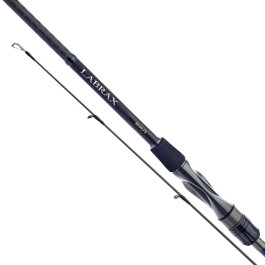
Daiwa Labrax Bass Lure Rods
Range overview covering five two-piece models
A dedicated bass lure range with posh blank construction, Fuji fittings and five quite different casting brackets. The clever bit is matching one to the lures you actually chuck.
- Five listed models span 7ft10 to 9ft6, with individual casting ranges from 3–19g through to 12–42g.
- All five listed models are two-piece rods.
- SVF nanoplus blanks combine X45 Bias Carbon Technology, Braiding X butt reinforcement and V-Joint Alpha joints.
- Fuji Titanium SiC guides are paired with a Fuji stainless-steel butt guide and Fuji TVS reel seat.
Make sure it’s the right one. This covers the Labrax range with SVF nanoplus blanks, X45, Braiding X and V-Joint Alpha joints. We haven't tested these rods on the bank or shore; the judgements below are based on their confirmed features and intended uses.
Tackle Index Score
Tackle Index score
Provisional feature-based scores, not hands-on ratings. Value is the least certain judgement because no verified selling price is supplied.
- Product Quality9.2/10
- Performance8.8/10
- Impact on Fish Catching7.9/10
- Ease of Use8.8/10
- Value for Money7.7/10
If you buy through our links, we might get a small kickback, but it won’t cost you a penny extra. As an Amazon Associate I earn from qualifying purchases. The full story
Who it suits
Is it right for you?
Great for
- Regular bass lure anglers with an established lure box. The different casting brackets make it possible to choose around your usual presentations rather than buying a vague do-everything rod.
- Anglers building a dedicated light or heavier lure outfit. The 8ft8 ML and 9ft6 MH serve clearly different weight ranges, giving each a sensible role alongside an existing rod.
Maybe skip if
- Anglers throwing heavy shore lures. The highest listed casting ceiling is 42g; heavier presentations need a rod rated for them.
- Carp and coarse anglers after a bait-fishing all-rounder. These are dedicated lure rods, not substitutes for a feeder rod, float rod or carp setup.
The lowdown
Introducing the Daiwa Labrax Bass Lure Rods
A dedicated bass lure range with posh blank construction, Fuji fittings and five quite different casting brackets. The clever bit is matching one to the lures you actually chuck.
- Five listed models span 7ft10 to 9ft6, with individual casting ranges from 3–19g through to 12–42g.
- All five listed models are two-piece rods.
- SVF nanoplus blanks combine X45 Bias Carbon Technology, Braiding X butt reinforcement and V-Joint Alpha joints.
- Fuji Titanium SiC guides are paired with a Fuji stainless-steel butt guide and Fuji TVS reel seat.
Quick verdict
Proper ingredients, but choose carefully
The Labrax has a cracking set of ingredients for dedicated bass lure fishing. Its blank construction, Fuji fittings and spread of casting weights make it an appealing range for anglers who already know their favourite lures and marks.
Don't buy on length alone, mate. The 8ft8 is rated lighter than the shorter 7ft10, while the two 9ft options cover different jobs. We haven't cast them, so actual balance, recovery and feel remain open questions.
Provisional feature-based scores, not hands-on ratings. Value is the least certain judgement because no verified selling price is supplied.
- Product Quality
- 9.2/10
- Performance
- 8.8/10
- Impact on Fish Catching
- 7.9/10
- Ease of Use
- 8.8/10
- Value for Money
- 7.7/10
The confirmed blank technologies and Fuji fittings form a strong component package, although finish and durability haven't been checked in use.
The model-specific casting brackets offer useful choices for bass lure work, but actual casting feel and recovery remain untested.
A well-matched model should support lure control and presentation, but finding feeding fish matters far more than the rod badge.
Two-piece construction and fingertip blank access are practical touches, though choosing between the overlapping models takes care.
The component package offers a credible reason to consider it, but without a verified price this remains a cautious provisional score.
Head to head
How it stacks up
Side by side with the closest kit we've reviewed. This updates as we add more reviews.
Daiwa
Daiwa Labrax Bass Lure Rods (this one)

Top scorer
Scores are our own, out of 10. Best in each row is in green. Prices change, so check the latest before you buy.
The full rundown
Everything you'll want to know about the Daiwa Labrax Bass Lure Rods
The Daiwa Labrax Bass Lure Rods are for the angler who would rather keep moving, cover water and make a lure do something interesting than sit behind alarms waiting for the rods to go off. Different game, same obsession. This is a dedicated bass lure range with some fairly posh ingredients, but the useful story isn't just the badges on the blank. It's the choice of lengths and casting brackets, and how well you can match those to the fishing you actually do.
First, a straight answer about where we're coming from: we haven't fished these rods. There's no invented dawn patrol, no mystery double-figure bass and no claim that one made every tap feel like a screaming take. What we can do is look at the confirmed construction and model choices, then explain where they make sense. That's particularly important here because the Labrax options aren't a simple ladder where every longer rod chucks a heavier lure. Get that assumption wrong and you could buy the wrong tool.
Take the 7ft10 M and the 8ft8 ML. The shorter rod is rated for 7–28g, while the longer one covers 3–19g. So, if your box is full of lighter presentations, the 8ft8 is the more relevant starting point despite its extra length. The 7ft10 offers a shorter format with a higher casting ceiling. For working lures where you've got limited room, that shorter length may appeal, although your stance, surroundings and preferred retrieve matter just as much as the number printed on the rod.
Then you've got two 9ft models, and this is where reading the label properly pays off. The ML covers 7–24g; the MH covers 7–35g. Same nominal length, different working brief. If your usual hard lures and rigged soft plastics sit comfortably within the lighter bracket, there's no automatic prize for choosing the heavier version. If you regularly need the extra weight allowance, the MH becomes the more sensible candidate. Neither rating tells us the exact sweet spot without casting it, so don't mistake the upper limit for a guaranteed favourite.
At the heavier end sits the 9ft6 MH, rated 12–42g. That's the model to investigate when your normal fishing involves weightier lures and you want more rod length for managing line around shore features. Extra reach can be dead handy, but it doesn't turn an awkward mark into a safe one or guarantee extra yards. Wind, lure shape, line and casting technique all have a say. Also, count the whole presentation: a jighead plus a chunky soft plastic can weigh rather more than the jighead label suggests.
Under the paint, Daiwa lists SVF nanoplus blank construction, X45 Bias Carbon Technology and Braiding X butt reinforcement. These are construction features aimed at delivering a responsive blank with resistance to unwanted twisting and support where it's needed. V-Joint Alpha handles the joins on these two-piece rods. That's a promising package on paper, but let's keep our feet on the shingle: those names don't prove how light a particular model feels in your hand, how quickly its tip settles or how it behaves with a fish under the rod tip.
The fittings are easier to picture in everyday use. You get Fuji Titanium SiC guides, with an important exception: the butt guide is Fuji stainless steel. There's a Fuji TVS reel seat too, plus a short foregrip that lets you put a fingertip against the blank. That contact may appeal when you're concentrating on a soft plastic rather than simply winding a lure straight back. Still, sensitivity isn't one component doing magic. Line bow, slack, lure weight and whether you're actually paying attention all influence what reaches your hand.
For a carp or coarse angler dipping a toe into bass fishing, the key is not to buy the biggest option just in case a lump turns up. Choose around your regular lure weights, the room you've got to cast and how you like to work the lure. If possible, fit your intended reel before buying and see whether the grip and balance suit you. The Labrax has plenty to get interested in; getting the right version is what makes that interest useful rather than an expensive bit of guesswork.
Specifications
The nuts and bolts
- 7ft10 model
- 7–28g casting weight; M designation; 2 sections
- 8ft8 model
- 3–19g casting weight; ML designation; 2 sections
- 9ft ML model
- 7–24g casting weight; 2 sections
- 9ft MH model
- 7–35g casting weight; 2 sections
- 9ft6 model
- 12–42g casting weight; MH designation; 2 sections
- Construction and fittings
- SVF nanoplus; X45; Braiding X butt reinforcement; V-Joint Alpha; Fuji Titanium SiC guides with stainless-steel butt guide; Fuji TVS reel seat; short foregrip
Specs checked with Daiwa, Oct 2026.
Spot a model or spec change?
Our take
Your lure box should choose the rod
Start with the complete weight of your usual lure, including the jighead where relevant, then think about reach and working space. That gets you much closer to the right Labrax than simply grabbing the longest one.
ML, M and MH describe the models' relative strength categories here. They don't, by themselves, tell you exactly where each blank bends or how crisply it recovers.
Build and fittings
Closer look: more than a list of carbon badges
The Labrax combines SVF nanoplus with X45 and Braiding X butt reinforcement. The intended benefit is a blank that responds cleanly while resisting unwanted distortion under load. That's relevant when you're repeatedly casting and working lures, but it isn't a substitute for feeling the chosen model with your own reel attached. We can't confirm its recovery speed or casting manners from the build list alone.
All five models split into two sections and use V-Joint Alpha joints. The Fuji TVS reel seat and short foregrip give you a fairly direct connection to the rod, including fingertip access to the blank. Check that this grip layout feels natural with the way you hold a spinning outfit; comfort matters when you're making cast after cast rather than resting the rod on a buzzer bar.
Worth knowing. The butt guide is stainless steel, not titanium. After saltwater use, gently rinse the guides, reel seat and blank with fresh water and let everything dry before packing it away. Fancy fittings still deserve a bit of care.
Picking your model
Who it suits: anglers choosing for a job
For lighter lure work, the 8ft8 ML's 3–19g bracket stands apart. The 7ft10 M gives you a shorter rod rated 7–28g, making it a candidate when manageable length matters more than extra reach. Neither is automatically better for a newcomer. Put your regular lures on a scale, then decide which bracket actually fits.
The two 9ft rods offer a choice between 7–24g ML and 7–35g MH without changing nominal length. The 9ft6 MH steps up to 12–42g. Those heavier options make sense when your presentations require them, not simply because you fancy catching a PB. Fish-fighting suitability also depends on the rest of your tackle, the terrain and how you manage the fish.
If you're only planning a cheeky seaside session or two, don't assume you need this level of componentry to get started. Likewise, frequent flyers may find a multi-piece travel rod easier to pack. The Labrax looks most convincing as a deliberate choice for regular lure fishing, with a clear job already waiting for it.
Before you buy
FAQs in full: the practical bits
Which model should you choose? Start with your most-used complete lure weights, not an imagined maximum-distance cast. Allow for the soft plastic as well as its jighead, and check hard-lure weights too. Then choose a length that suits your marks and retrieve style. Remember that the 8ft8 is the lightest-rated option, not the shortest one.
Are all the guides titanium-framed? No: the listed arrangement is Fuji Titanium SiC guides with a Fuji stainless-steel butt guide. That's the larger guide nearest the reel. It's a mixed arrangement, so don't buy expecting titanium throughout.
Can you use one for freshwater predators? There's no saltwater-only switch in a rod, mate. A suitable model could cross over where its casting range and overall tackle match the job. But don't treat that as blanket approval for heavy pike fishing or tiny perch lures. Use appropriate bite protection where pike are present, and choose tackle with fish welfare and landing conditions in mind.
On paper
Pros & cons
What we like
- Distinct casting brackets let you match the rod to your regular lure fishing.
- A strong component package, including Fuji guides and a TVS reel seat.
- Short foregrip allows direct fingertip contact with the blank.
- Two-piece construction makes transport less of a faff than a one-piece rod.
Worth knowing
- The model names need careful reading: greater length doesn't always mean a heavier casting range.
- Even the 9ft6 tops out at 42g, so heavier shore lures fall outside this range.
- Two-piece construction is less compact for travel than a dedicated multi-piece travel rod.
Want one?
Add it to your Wanted list or join a Group Buy — shops see anonymous totals only.
Your questions answered
What anglers want to know
The stuff you’d ask your mate on the next peg. Straight answers, no waffle.
01Which Labrax should I choose?
Which Labrax should I choose?
Choose by complete lure weight first, then length. The 8ft8 covers 3–19g, the 7ft10 covers 7–28g, the 9ft ML covers 7–24g, the 9ft MH covers 7–35g and the 9ft6 covers 12–42g. Think about your regular lures rather than the occasional heaviest one.
02Are all the guides titanium-framed?
Are all the guides titanium-framed?
No. The listed build uses Fuji Titanium SiC guides with a Fuji stainless-steel butt guide. Calling the whole guide train titanium would miss that distinction.
03Can I use these rods for freshwater predators?
Can I use these rods for freshwater predators?
Potentially, yes, where lure weights, tackle strength and the fishery suit the chosen model. They're sold as bass lure rods, though, and a casting rating alone doesn't make one suitable for every pike or perch job.
What anglers say
The word from the bank
Our read: proper ingredients, but choose carefully. The strongest reasons to choose it are distinct casting brackets let you match the rod to your regular lure fishing. and a strong component package, including fuji guides and a tvs reel seat.; the main trade-off is the model names need careful reading: greater length doesn't always mean a heavier casting range..
Our take on the feedback
Why it appeals
Checked Sept '26 — “Distinct casting brackets let you match the rod to your regular lure fishing.”
Best fit
Checked Sept '26 — “Regular bass lure anglers with an established lure box: The different casting brackets make it possible to choose around your usual presentations rather than buying a vague do-everything rod.”
Worth knowing
Checked Sept '26 — “The model names need careful reading: greater length doesn't always mean a heavier casting range.”
Tackle Index’s take from the product details and fishing fit we checked. We haven’t found enough independent public feedback to call this an angler consensus yet.
Angler score
What our readers rate Daiwa Labrax Bass Lure Rods
No angler score yet — nobody's reviewed Daiwa Labrax Bass Lure Rods here. Be the first and get the score started.
Owner reports
Own this? Help the next angler.
Quick multiple-choice reports from people who say they own the Daiwa Labrax Bass Lure Rods. Not verified purchases, and kept separate from our score.
No owner reports yet.
Alternatives & go-withs