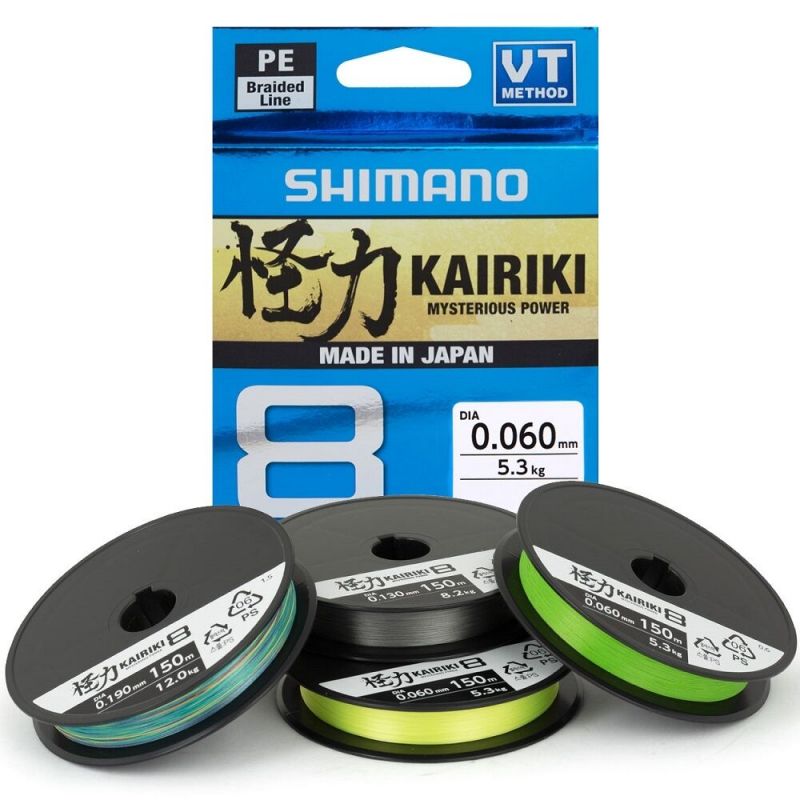
Photos: Shimano · supplied retailer imagery
Predator tackle · Braided mainline · Our take
Shimano Kairiki 8
Kairiki 8 range; diameter, colour and spool length vary
An eight-carrier mainline with a tight weave and plenty of predator appeal. Kairiki 8 makes sense for anglers who want direct lure contact, provided you choose the right strength and sort your leader properly.
- Eight-carrier braid made with IZANAS ultra-high-strength polyethylene fibre.
- Uses Shimano’s tight-weave VT Construction.
- Manufactured in Japan, with freshwater and saltwater applications.
- Options include 150 m spools and a 300 m Mantis Green spool; check the individual version.
Make sure it’s the right one. This review covers Shimano Kairiki 8, rather than a single diameter or spool size. Breaking strength depends on the version you choose.
Tackle Index Score
Tackle Index score
A well-rounded lure-fishing braid whose strongest appeal is smooth handling and direct contact, with the usual need for careful line management.
- Product Quality9/10
- Performance8.9/10
- Impact on Fish Catching8.3/10
- Ease of Use8.6/10
- Value for Money8.6/10
If you buy through our links, we might get a small kickback, but it won’t cost you a penny extra. As an Amazon Associate I earn from qualifying purchases. The full story
Who it suits
Is it right for you?
Great for
- Perch and zander lure anglers. The low-stretch connection suits jigging, soft-plastic work and keeping track of a lure as it sinks.
- Predator anglers building a matched outfit. The wide size range lets you choose braid around the lure weight, cover and reel rather than forcing one strength onto every job.
Maybe skip if
- Anglers wanting mono-like forgiveness. Braid leaves more of the cushioning to your rod and drag, especially during short-range lunges.
- Anglers expecting a leader-free answer to teeth and rough ground. Its strength rating doesn’t make it tooth-proof or immune to damage from sharp structure.
The lowdown
Introducing the Shimano Kairiki 8
An eight-carrier mainline with a tight weave and plenty of predator appeal. Kairiki 8 makes sense for anglers who want direct lure contact, provided you choose the right strength and sort your leader properly.
- Eight-carrier braid made with IZANAS ultra-high-strength polyethylene fibre.
- Uses Shimano’s tight-weave VT Construction.
- Manufactured in Japan, with freshwater and saltwater applications.
- Options include 150 m spools and a 300 m Mantis Green spool; check the individual version.
Quick verdict
A cracking fit for lure work
Kairiki 8 has the right ingredients for a capable predator mainline: eight-carrier construction, a tight weave and a broad choice of sizes. Its biggest appeal is keeping you connected to the lure without making casting feel unnecessarily clunky.
Buy it for controlled lure fishing, not because braid magically puts more fish on the bank. Match the diameter to the job, use a suitable leader and keep an eye on wear. Get those basics bob on and it’s a sensible all-round choice.
A well-rounded lure-fishing braid whose strongest appeal is smooth handling and direct contact, with the usual need for careful line management.
- Product Quality
- 9/10
- Performance
- 8.9/10
- Impact on Fish Catching
- 8.3/10
- Ease of Use
- 8.6/10
- Value for Money
- 8.6/10
IZANAS fibre, eight-carrier construction and the tight VT weave make a convincing build for a general-purpose predator braid.
The construction suits repeated lure casting and controlled retrieves, although the rest of your setup still shapes the result.
Low stretch can help you read lure movement and bites, but presentation and fish location remain far more important.
It fits familiar braid setups but still needs tidy spooling, suitable knots and sensible drag settings.
Its versatile construction makes a sensible upgrade if you’ll use braid’s benefits, though value depends on the spool size and price you find.
Head to head
How it stacks up
Side by side with the closest kit we've reviewed. This updates as we add more reviews.
Shimano
Shimano Kairiki 8 (this one)
Top scorer
Scores are our own, out of 10. Best in each row is in green. Prices change, so check the latest before you buy.
The full rundown
Everything you'll want to know about the Shimano Kairiki 8
Shimano Kairiki 8 is a braided mainline that makes most sense when you’re actively working a lure rather than chucking it out and hoping for the best. Think soft plastics for perch, jigs for zander or a properly matched pike outfit. You want to know when the lure touches down, when it catches a bit of weed and when something interrupts the retrieve. Braid gives you that direct connection, and Kairiki 8 pairs it with an eight-carrier build aimed at smooth line travel. A useful combination, mate.
The nuts and bolts are straightforward. It’s made from IZANAS ultra-high-strength polyethylene fibre, uses Shimano’s tight-weave VT Construction and is manufactured in Japan. Eight-carrier describes the braided construction, not a promise that it’ll outfish every other line on the shelf. The practical attraction is a tightly woven line that suits repeated casting and retrieving. If you spend a session covering water with a shad, that’s more relevant than fancy wording on a spool. You’re buying a working part of the outfit, not a shortcut to a PB.
Contact is the main reason to put it on a predator reel. With very little stretch compared with mono, braid helps carry changes in resistance back towards your hand. That can help when you’re hopping a jig along the bottom or steering a lure above weed. Don’t expect every tap to announce itself like a screaming take, though. Wind, a big bow in the line and an unsuitable jig weight can all muddy the picture. Keep your line reasonably controlled without dragging the lure out of its intended path.
Choosing the size deserves more thought than grabbing the thinnest one you can find. The listed range runs from 0.06 to 0.42 mm, so this isn’t one line size trying to cover every predator job. Shimano lists a 150 m Mantis Green version at 0.06 mm and 5.3 kg, and another at 0.10 mm and 6.5 kg. Those are particular options, not instructions to use either everywhere. Lure weight, snags, rod rating and the fish you’re likely to meet should decide what goes in your basket.
Colour is a practical choice too. Kairiki 8 comes in Yellow, Mantis Green, Multi and Steel Grey, although you’ll need to check which combinations are offered in your chosen size and spool length. A visible mainline can be dead handy when you’re watching for a twitch as a lure drops, especially if feeling the bite alone isn’t giving you much to go on. A muted colour may suit your preference elsewhere. Neither approach removes the need for good presentation, and mainline colour alone won’t turn a quiet swim into a feeding frenzy.
Leaders are where you need to keep your sensible head on. For plenty of perch and zander presentations, a suitable mono or fluorocarbon leader gives you a useful section between the braid and lure. Where pike are a realistic possibility, use a proper bite-resistant trace, usually wire. Don’t look at a big breaking-strain figure and assume that means tooth protection. It doesn’t. The same goes for scraping over sharp stone or metalwork: check the working end regularly, and cut back damaged line rather than gambling your next fish on it.
Spooling matters just as much as the name on the packet. Put the braid on under steady tension and follow your reel’s filling guidance rather than packing it right to the brim. If the reel needs backing to stop braid slipping around the spool, sort that first. During the session, close a spinning reel’s bail by hand and avoid winding loose loops onto the spool. None of that is glamorous, but it’s the sort of small habit that prevents a proper bird’s nest just as you’ve found a promising spot.
The buying decision comes down to whether you want braid’s directness and are happy to manage it properly. There are 150 m options, plus a listed 300 m Mantis Green spool, so think about reel capacity and backing before choosing. Kairiki 8 looks a sensible fit for a versatile lure outfit, but it won’t do the rod and drag’s job when a fish lunges under your feet. Leave some cushioning in the system. Smooth line, tidy line lay and a balanced setup: that’s the useful package here.
Specifications
The nuts and bolts
- Construction
- 8-carrier braid with tight-weave VT Construction
- Material
- IZANAS ultra-high-strength polyethylene fibre
- Manufacture
- Japan
- Listed diameter range
- 0.06–0.42 mm
- Spool options
- 150 m options; 300 m Mantis Green also listed
- Colours
- Yellow, Mantis Green, Multi and Steel Grey
Specs checked with Shimano, Oct 2026.
Spot a model or spec change?
Our take
Contact first, brute strength second
For perch and zander fishing, feeling what your lure is doing can matter more than chasing a huge breaking-strain figure. Kairiki 8’s low-stretch braided construction helps transmit changes in resistance while you work a lure.
That directness needs managing when a fish is close in. Let the rod and drag cushion lunges, and don’t mistake a strong braid for protection against pike teeth or sharp underwater edges.
Construction and setup
Closer look: what you’re buying
Kairiki 8 combines eight-carrier construction with Shimano’s tight-weave VT Construction. That gives it a clear role as a casting and lure-working mainline. The sensible expectation is smooth line handling and a direct connection, rather than a guaranteed extra few yards on every cast. Rod rings, reel filling, lure shape and wind still have their say.
Treat diameter and breaking strain as a pair when choosing your spool. Don’t assume two different braids with the same stated diameter will behave identically. For heavier lures or snaggy water, allow a sensible margin rather than chasing maximum fineness. Your knots also need care: use a braid-suitable connection, tie it neatly and check it under controlled tension before fishing.
Worth knowing. The listed maximum breaking strength of 46.7 kg belongs to the top end of the range. It doesn’t apply to every Kairiki 8 spool, and it certainly doesn’t make the finer versions suitable for heavy pike lures.
Picking the right job
Who it suits: anglers who want to work the lure
Perch and zander anglers have an obvious use for it. When you’re fishing soft plastics, watching the line and feeling changes through the rod work together. A low-stretch mainline helps that partnership, particularly when you maintain a controlled connection as the lure sinks. Just don’t keep everything so tight that you spoil the drop you’re trying to achieve.
Pike anglers can look further up the size range, choosing around lure weight, cover and the outfit as a whole. Saltwater lure anglers are catered for too, since Kairiki 8 is listed for both freshwater and sea use. In either case, strength is only one part of the job; trace choice and protection from sharp structure need their own attention.
It’s less appealing if you mainly want a forgiving line that stretches when things get lively. Braid demands a little more discipline with drag settings and line lay. It can still suit someone moving over from mono, but make that switch with a balanced setup rather than simply locking the clutch and carrying on as before.
Before you spool up
FAQs in full: size, leaders and saltwater
Which size should you choose? Start with your lure weights and the rod’s recommended line range, then factor in snags and likely fish. The 0.06 mm and 0.10 mm Mantis Green examples are rated at 5.3 kg and 6.5 kg respectively, but don’t pick on strength alone. Fine braid can be useful for lighter presentations; tougher jobs call for a more substantial setup.
Do you need a leader? For many lure approaches, a suitable leader is a practical addition. Choose its material and strength for the presentation and underwater hazards, then use a connection you can tie reliably. If pike might take the lure, fit a proper bite-resistant trace. A tidy knot won’t rescue an unsuitable leader from sharp teeth.
Can you use it in saltwater? Yes, that’s within its stated applications. Match the braid to your sea-fishing outfit rather than assuming your light perch spool will cover the job. Around rough ground, inspect the working end frequently and choose suitable leader protection. Give the rest of your tackle its recommended freshwater clean afterwards, too.
On paper
Pros & cons
What we like
- Tight eight-carrier construction is well suited to smooth line travel during lure casting.
- Low stretch helps you keep track of lure movement and changes in resistance.
- Broad diameter range covers very different predator setups.
- Four colour options let you prioritise visibility or a more muted mainline.
Worth knowing
- Low stretch gives less cushioning than mono when a fish lunges close in.
- Fine braid needs care around sharp edges and should never replace a pike trace.
- Loose line lay and overfilling can still cause tangles, regardless of the eight-carrier weave.
Want one?
Add it to your Wanted list or join a Group Buy — shops see anonymous totals only.
Your questions answered
What anglers want to know
The stuff you’d ask your mate on the next peg. Straight answers, no waffle.
01Which Kairiki 8 size should I buy?
Which Kairiki 8 size should I buy?
Match it to lure weight, the rod’s recommended line range and the cover you’re fishing. Shimano lists the 150 m Mantis Green 0.06 mm version at 5.3 kg and the 0.10 mm version at 6.5 kg, but those figures aren’t blanket recommendations for every perch or predator setup.
02Do I need a leader with Kairiki 8?
Do I need a leader with Kairiki 8?
A suitable mono or fluorocarbon leader is useful for many perch and zander presentations. Where pike are a realistic possibility, use a proper bite-resistant trace, usually wire. Ordinary lure leaders and braided mainline aren’t reliable protection against pike teeth.
03Is Kairiki 8 suitable for sea fishing?
Is Kairiki 8 suitable for sea fishing?
Yes. Shimano lists freshwater and saltwater applications. Choose a size suited to the tackle and conditions, and pay particular attention to leader protection around rocks and other sharp structure.
What anglers say
The word from the bank
Our read: a cracking fit for lure work. The strongest reasons to choose it are tight eight-carrier construction is well suited to smooth line travel during lure casting. and low stretch helps you keep track of lure movement and changes in resistance.; the main trade-off is low stretch gives less cushioning than mono when a fish lunges close in..
Our take on the feedback
Why it appeals
Checked Sept '26 — “Tight eight-carrier construction is well suited to smooth line travel during lure casting.”
Best fit
Checked Sept '26 — “Perch and zander lure anglers: The low-stretch connection suits jigging, soft-plastic work and keeping track of a lure as it sinks.”
Worth knowing
Checked Sept '26 — “Low stretch gives less cushioning than mono when a fish lunges close in.”
Tackle Index’s take from the product details and fishing fit we checked. We haven’t found enough independent public feedback to call this an angler consensus yet.
Angler score
What our readers rate Shimano Kairiki 8
No angler score yet — nobody's reviewed Shimano Kairiki 8 here. Be the first and get the score started.
Owner reports
Own this? Help the next angler.
Quick multiple-choice reports from people who say they own the Shimano Kairiki 8. Not verified purchases, and kept separate from our score.
No owner reports yet.
Alternatives & go-withs