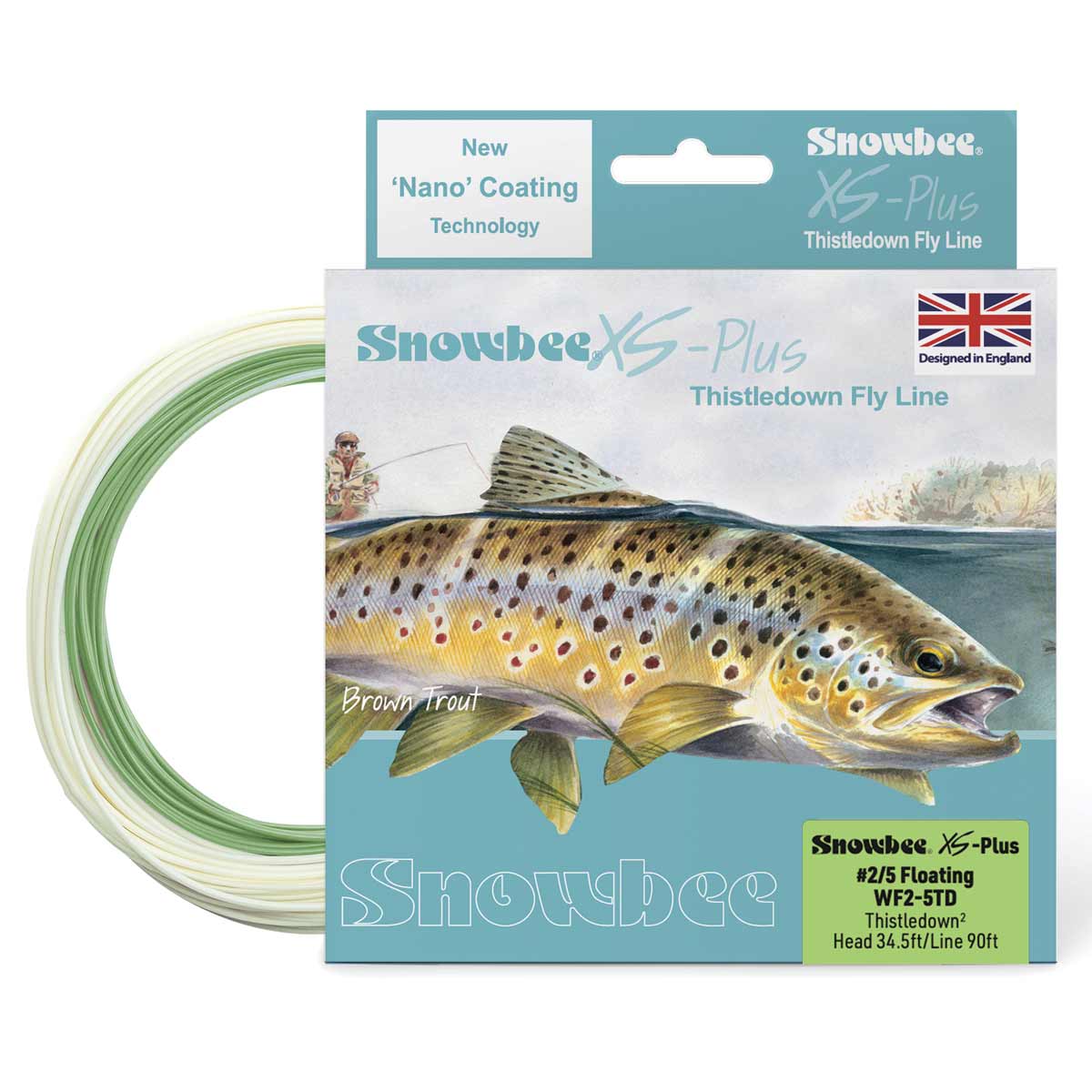
Photos: Snowbee · supplied retailer imagery
Fly fishing · Floating fly lines · Our take
Snowbee XS-Plus Thistledown Fly Line
Floating WF · WF1/4, WF2/5 and WF5/7 · Olive/buckskin
A weight-forward floating fly line with multi-rating options, looped ends and a braided core. Properly useful for trout fishing, provided you don’t mistake its broad ratings for a promise that every rod will feel the same.
- Floating, weight-forward fly line in olive/buckskin.
- Available in WF1/4, WF2/5 and WF5/7 rating options.
- 90 ft / 30 yd overall; head lengths vary by option.
- Braided core, NCT coating and micro-welded loops at both ends.
Make sure it’s the right one. This review covers the floating XS-Plus Thistledown in the listed multi-rating options. Check the version and rating on the box when ordering.
Tackle Index Score
Tackle Index score
A well-equipped floating line with useful connection details and an appealing multi-rating approach. Rod matching remains the key buying decision; value depends on whether this is the line type your fishing needs.
- Product Quality8.8/10
- Performance8.8/10
- Impact on Fish Catching8/10
- Ease of Use8.6/10
- Value for Money8.3/10
If you buy through our links, we might get a small kickback, but it won’t cost you a penny extra. As an Amazon Associate I earn from qualifying purchases. The full story
Who it suits
Is it right for you?
Great for
- Trout anglers fishing dries and shallow subsurface methods. A floating line lets you work surface presentations and fish nymphs below a leader without making the whole fly line sink.
- Anglers happy to think beyond a single rod rating. The overlapping rating ranges offer flexibility, especially when you understand how casting distance changes rod loading.
Maybe skip if
- Anglers concentrating on deep reservoir work. A dedicated sinking line is generally a better tool for keeping the whole presentation down.
- Buyers wanting an exact conventional single-weight match. The multi-rating approach needs a little interpretation rather than a simple like-for-like number swap.
The lowdown
Introducing the Snowbee XS-Plus Thistledown Fly Line
A weight-forward floating fly line with multi-rating options, looped ends and a braided core. Properly useful for trout fishing, provided you don’t mistake its broad ratings for a promise that every rod will feel the same.
- Floating, weight-forward fly line in olive/buckskin.
- Available in WF1/4, WF2/5 and WF5/7 rating options.
- 90 ft / 30 yd overall; head lengths vary by option.
- Braided core, NCT coating and micro-welded loops at both ends.
Quick verdict
A versatile floater, with rod matching still part of the job
The Thistledown makes a cracking case for itself if you want a floating trout line with straightforward connections and a choice of broad rod-rating ranges. Its weight-forward profile, braided core and NCT coating give it a well-rounded feature set.
The catch? Those overlapping ratings aren’t a magic fit for every rod and casting style. Pick around your usual rod, fly size and fishing distance, and remember that a floater won’t replace a sinking line when the fish are properly down.
A well-equipped floating line with useful connection details and an appealing multi-rating approach. Rod matching remains the key buying decision; value depends on whether this is the line type your fishing needs.
- Product Quality
- 8.8/10
- Performance
- 8.8/10
- Impact on Fish Catching
- 8/10
- Ease of Use
- 8.6/10
- Value for Money
- 8.3/10
The braided core, NCT coating and micro-welded loops make a well-rounded construction package.
The floating WF design offers useful trout-fishing versatility, provided the rating and head suit your outfit.
Appropriate line choice supports presentation and control, but leader setup and drift remain crucial.
Looped ends and a tagged backing attachment simplify setup, though the broad ratings need some thought.
The feature set makes a sensible case for regular floater users, without assuming it can replace every other line.
Head to head
How it stacks up
Side by side with the closest kit we've reviewed. This updates as we add more reviews.
Snowbee
Snowbee XS-Plus Thistledown Fly Line (this one)
Top scorer
Scores are our own, out of 10. Best in each row is in green. Prices change, so check the latest before you buy.
The full rundown
Everything you'll want to know about the Snowbee XS-Plus Thistledown Fly Line
The Snowbee XS-Plus Thistledown is a floating fly line with a slightly different answer to the usual rod-matching question. Instead of one familiar weight number, you get a choice of WF1/4, WF2/5 or WF5/7. That’s the bit to get your head around before anything else. It’s still a weight-forward line for fly fishing, not some mysterious new method. But those wider rating ranges make it an interesting option if you’re choosing a trout floater and don’t want to judge everything by one number printed on the rod.
First, the everyday fishing bit. A floating line is the starting point for dry-fly work, but it isn’t restricted to watching a little fly bob about on top. You can fish nymphs underneath it, work wets through shallower water or use a suitable leader and weighted fly to explore below the surface. That makes this type of line dead handy across plenty of river and stillwater situations. The limit is depth control: when you need the line itself to sink and stay down, this isn’t the tool for that job.
Those rating ranges deserve a bit of thought rather than a quick 'bosh, that’ll fit'. Fly rods load against the mass you’re moving, and the amount of fly line outside the tip matters. A rod used for short flicks under overhanging branches can feel quite different from the same rod carrying more line over open water. So a broad rating range shouldn’t be read as a promise of identical behaviour throughout it. Start with your rod rating, then think about the distances you actually fish and the flies you normally carry.
There’s a useful difference between the options beyond their names, too. The WF1/4 has a 27 ft head, while the WF2/5 and WF5/7 each have a 34 ft head. Overall length is 90 ft across the listed options. Head length matters because it helps shape how you manage the weighted section during a cast; it isn’t just a measurement to ignore once the line’s on the reel. For close work especially, consider how much of that head will be outside the tip rather than choosing solely around maximum casting distance.
Construction-wise, you’re getting a braided core and Snowbee’s Nano Coating Technology, usually shortened to NCT. The coating is part of the line’s casting and handling package, but don’t expect a fancy name to replace basic care. Grit and muck are no favours to any fly line. Keep it out from under your boots, avoid dragging loose coils through gravel and clean it using the maker’s guidance. A little attention between trips is far less faff than trying to shoot a dirty line when a fish starts rising just beyond comfortable range.
The connections are nicely straightforward on paper: micro-welded loops at both the front and rear, plus a tag identifying the backing attachment end. That last detail sounds tiny until you picture winding a whole line on backwards. Nobody needs that palaver before a session. The front loop makes swapping a looped leader simple, while the rear gives you a ready-made attachment point for an appropriate backing connection. Seat everything neatly, check it under tension and inspect the loops regularly rather than assuming a tidy-looking connection can be forgotten forever.
The olive/buckskin colour scheme is another clear identifying detail, though colour alone doesn’t make a presentation subtle. Your approach, casting angle, leader and drift still do the heavy lifting. On a river, getting a dry to travel naturally through a feeding lane matters far more than admiring the line. On a stillwater, avoiding a heap of slack when you need contact can be just as important. Think of the Thistledown as part of that whole setup, not a shortcut around sound technique or a guarantee that reluctant trout will suddenly get on the munch.
The buying decision, then, is fairly grounded. If your fishing revolves around a floating line and you’re comfortable choosing within these broader ratings, there’s plenty here to like. Looped ends reduce setup faff, the tagged rear end is sensible, and the three options cover distinctly different rod choices. If you mainly fish deep or want an exact conventional single-weight replacement, pause before ordering. Match it to the job first, mate. A well-chosen floater is useful tackle; the wrong type of line is still the wrong type, however smart its feature list looks.
Specifications
The nuts and bolts
- Density and profile
- Floating; weight-forward (WF)
- Overall length
- 90 ft / 30 yd
- Available ratings
- WF1/4, WF2/5 and WF5/7
- Head lengths
- WF1/4: 27 ft; WF2/5 and WF5/7: 34 ft
- Construction
- Braided core with Nano Coating Technology (NCT)
- Colour and connections
- Olive/buckskin; micro-welded front and rear loops; tagged backing end
Specs checked with Snowbee, Oct 2026.
Spot a model or spec change?
Our take
The rating range is the talking point
Rather than choosing a conventional single-number WF line, you’re choosing between WF1/4, WF2/5 and WF5/7. That flexibility is appealing, but the amount of line outside the rod tip still changes how the rod loads.
The WF1/4 has a 27 ft head; the WF2/5 and WF5/7 have 34 ft heads. That’s a meaningful difference to consider alongside the rating, especially if most of your fishing happens at short range.
Design and setup
Closer look: the head and connections matter
The Thistledown combines a floating WF profile with a braided core and NCT coating. Weight-forward describes the distribution of the line’s casting mass; it doesn’t mean you have to fish at distance. Choose around your normal fishing rather than the longest cast you might attempt once a season.
The 27 ft head on the WF1/4 and 34 ft heads on the other two options are worth keeping separate in your mind. Head length alone won’t tell you exactly how a line will feel, but it does affect how much of the head you can carry outside the tip at a given fishing distance. The supplied figures don’t justify treating these as identical tapers with different labels.
Worth knowing. Find the tagged backing end before spooling. Connect that end towards the backing, leave the front loop for your leader, and make sure the reel still has comfortable clearance once everything is loaded.
Picking your setup
Who it suits: anglers who actually need a floater
Dry-fly anglers and trout fishers mixing surface work with shallow nymph or wet-fly presentations are the natural audience. A floater gives you a visible line to manage and mend, while the leader takes your fly to its working depth. Adjust that leader to the fly and conditions rather than expecting one arrangement to cover everything.
The overlapping ratings may appeal if you use more than one rod, but don’t assume a single line will make every outfit equally happy. Rod action, line carried and your preferred casting rhythm all matter. If you’re unsure between two options, ask a knowledgeable fly shop about your exact rod and usual fishing distance.
It’s less convincing as your only line if deep reservoir fishing dominates your season. Weighted flies and longer leaders can get below a floater, but that isn’t the same as using a sinking line to manage depth along the whole presentation. Buy for your regular fishing, not a heroic workaround.
Straight answers
FAQs in full: ratings, depth and rigging
Is it floating? Yes. This is a floating weight-forward fly line. A nymph can sink beneath it, but that doesn’t turn it into an intermediate or sinker. If your plan relies on the fly line cutting down through the water, choose a different density.
How do the ratings work? WF1/4, WF2/5 and WF5/7 denote broad intended rod-rating ranges rather than conventional single-weight labels. Where those ranges overlap, don’t pick purely because both include your rod number. Consider head length, typical casting distance and the feel you want from the outfit.
Are both ends looped? Yes, with micro-welded loops. The backing end is also tagged. A looped leader can attach at the front using a neat loop-to-loop connection; check that it seats correctly and inspect for wear during routine tackle checks.
On paper
Pros & cons
What we like
- Three multi-rating options give you more to consider than a single rod number.
- Floating profile suits dries and plenty of shallow subsurface trout work.
- Micro-welded loops at both ends simplify connections.
- Tagged backing end helps avoid a backwards-spooling faff.
Worth knowing
- Broad ratings need a bit more thought than a familiar single-number line match.
- Floating construction limits its usefulness for sustained deep-water presentations.
- Different head lengths mean the three options aren’t simply interchangeable versions of the same setup.
Want one?
Add it to your Wanted list or join a Group Buy — shops see anonymous totals only.
Your questions answered
What anglers want to know
The stuff you’d ask your mate on the next peg. Straight answers, no waffle.
01Is the Thistledown a floating or sinking line?
Is the Thistledown a floating or sinking line?
It’s a floating weight-forward line. You can fish a weighted fly below it, but the fly line itself is designed to stay afloat.
02What do WF1/4, WF2/5 and WF5/7 mean?
What do WF1/4, WF2/5 and WF5/7 mean?
They identify the line’s intended rod-rating ranges: 1–4, 2–5 and 5–7 respectively. They aren’t breaking strains, and they don’t guarantee an identical feel on every rod within the range.
03Does it come with loops?
Does it come with loops?
Yes. There are micro-welded loops at the front and back, and the backing attachment end is tagged to help you spool it the right way round.
What anglers say
The word from the bank
Our read: a versatile floater, with rod matching still part of the job. The strongest reasons to choose it are three multi-rating options give you more to consider than a single rod number. and floating profile suits dries and plenty of shallow subsurface trout work.; the main trade-off is broad ratings need a bit more thought than a familiar single-number line match..
Our take on the feedback
Why it appeals
Checked Sept '26 — “Three multi-rating options give you more to consider than a single rod number.”
Best fit
Checked Sept '26 — “Trout anglers fishing dries and shallow subsurface methods: A floating line lets you work surface presentations and fish nymphs below a leader without making the whole fly line sink.”
Worth knowing
Checked Sept '26 — “Broad ratings need a bit more thought than a familiar single-number line match.”
Tackle Index’s take from the product details and fishing fit we checked. We haven’t found enough independent public feedback to call this an angler consensus yet.
Angler score
What our readers rate Snowbee XS-Plus Thistledown Fly Line
No angler score yet — nobody's reviewed Snowbee XS-Plus Thistledown Fly Line here. Be the first and get the score started.
Owner reports
Own this? Help the next angler.
Quick multiple-choice reports from people who say they own the Snowbee XS-Plus Thistledown Fly Line. Not verified purchases, and kept separate from our score.
No owner reports yet.
Alternatives & go-withs