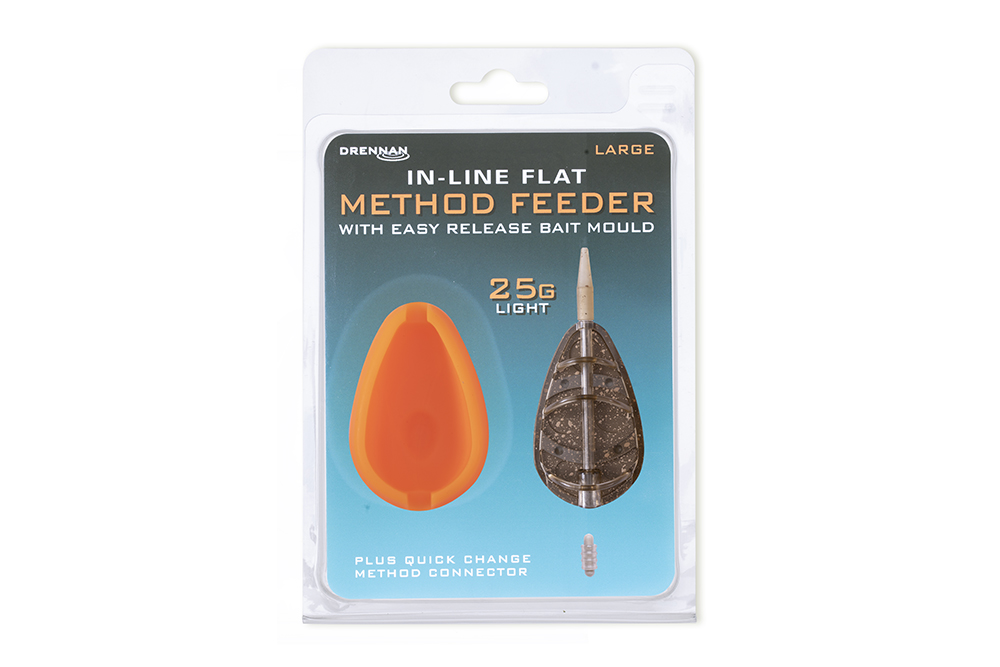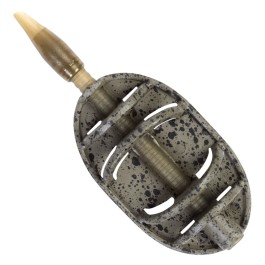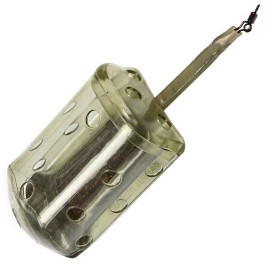
Photos: Drennan · supplied retailer imagery
Feeders · Blockend feeders · Our take
Drennan Oval Blockend Feeders
Standard and Heavy · Small, Medium and Large
A proper no-faff blockend feeder, with a flat lead base and separate Standard and Heavy options that let you add weight without automatically upping the bait.
- Standard weights: Small 28g, Medium 42g, Large 56g.
- Heavy weights: Small 42g, Medium 56g, Large 70g.
- Strong polymer body with a flat lead base moulded into the feeder.
- Low-profile oval design for river and stillwater fishing.
Make sure it’s the right one. This covers Drennan Oval Blockend Feeders in both the Olive Green Standard range and Camo Brown Heavy range.
Tackle Index Score
Tackle Index score
A well-considered conventional feeder range, strongest on practical shape and the freedom to choose weight separately from nominal body size.
- Product Quality8.8/10
- Performance8.9/10
- Impact on Fish Catching8.3/10
- Ease of Use9.1/10
- Value for Money8.5/10
If you buy through our links, we might get a small kickback, but it won’t cost you a penny extra. As an Amazon Associate I earn from qualifying purchases. The full story
Who it suits
Is it right for you?
Great for
- River anglers fishing a maggot feeder. The low profile and choice of heavier bodies help you balance bait delivery with the weight needed to fish your swim.
- Stillwater anglers building a measured loose-feed approach. Three body sizes let you adjust the amount carried rather than committing to a big helping every cast.
Maybe skip if
- Anglers fishing very powerful river flows. Even the 70g Heavy Large may not provide enough weight, and this isn’t a dedicated gripping feeder.
- Anglers wanting an open groundbait presentation. A cage or open-end feeder is a more natural starting point when you want groundbait to break out freely.
The lowdown
Introducing the Drennan Oval Blockend Feeders
A proper no-faff blockend feeder, with a flat lead base and separate Standard and Heavy options that let you add weight without automatically upping the bait.
- Standard weights: Small 28g, Medium 42g, Large 56g.
- Heavy weights: Small 42g, Medium 56g, Large 70g.
- Strong polymer body with a flat lead base moulded into the feeder.
- Low-profile oval design for river and stillwater fishing.
Quick verdict
A sensible feeder for getting the basics bob on
The appeal is straightforward, mate: an enclosed bait chamber, a low-profile body and a flat lead base. It’s a useful combination for maggot feeder fishing on rivers and stillwaters, without turning your tackle tray into a science project.
The separate Heavy range is the clever bit. You can choose more weight in the same nominal body size rather than feed more just to help your rig hold position. Don’t mistake it for a dedicated distance feeder or a guaranteed answer to powerful flow, though.
A well-considered conventional feeder range, strongest on practical shape and the freedom to choose weight separately from nominal body size.
- Product Quality
- 8.8/10
- Performance
- 8.9/10
- Impact on Fish Catching
- 8.3/10
- Ease of Use
- 9.1/10
- Value for Money
- 8.5/10
The strong polymer body and moulded-in lead base make a sensible construction for regular feeder fishing.
A low profile, flat base and six size-and-weight combinations give it useful scope across rivers and stillwaters.
Controlled bait delivery can support a consistent feeding approach, but location and presentation still do the heavy lifting.
The conventional blockend format and clearly separated Standard and Heavy ranges keep selection straightforward.
Its practical construction and versatile range make a sensible utility purchase, though the asking price will decide the final value.
Head to head
How it stacks up
Side by side with the closest kit we've reviewed. This updates as we add more reviews.
Top scorer
Scores are our own, out of 10. Best in each row is in green. Prices change, so check the latest before you buy.
The full rundown
Everything you'll want to know about the Drennan Oval Blockend Feeders
Some feeders earn their place in the tackle box by doing a fairly ordinary job properly. That’s the appeal of the Drennan Oval Blockend Feeders. You’re looking at an enclosed feeder for delivering loose feed, with live maggots the obvious starting point, rather than a Method-style platform for moulding bait around your hookbait. The oval body sits low, the lead base is flat, and the range gives you a useful spread of sizes and weights. Nothing flashy, mate. Just a sensible shape for a familiar bit of feeder fishing.
That shape matters most when you think about what happens after the splash. A feeder needs to settle somewhere useful, not just reach the far side of the swim. The streamlined, low-profile body and flat lead base are sensible features for keeping things stable on the bottom. They don’t make it immune to river flow, line pressure or an awkward slope, obviously. But they give this design a clear purpose: delivering feed from a compact body that isn’t standing unnecessarily tall in the water.
The buying choice is nicely split between body size and weight. Standard Small is 28g, Medium is 42g and Large is 56g. Move to the Heavy range and those sizes become 42g, 56g and 70g respectively. That means a heavier feeder doesn’t automatically have to be a bigger bait carrier. It’s a proper useful distinction on a river, where the amount of lead needed to fish a spot and the amount of grub you want to introduce can be two completely different things.
Picture the decision on a cold day rather than assuming bigger is better. You might want a modest helping of maggots but need extra weight to resist the pull on your line. The Heavy Small gives you that option without moving up to a nominally larger body. Equally, when fish are on the munch, a larger chamber can make more sense. Body size controls what you can carry, while how fully you load it and how often you cast also shape your feeding. Keep all three in mind.
On stillwaters, there’s no need to treat the Heavy label as an upgrade you automatically need. Choose enough weight to cast comfortably and maintain a useful connection to the feeder, then concentrate on putting it back on the same spot. Clip up where it’s safe and appropriate, pick a clear far-bank marker and cushion the cast. Accurate, repeatable feeding generally does more for your approach than swapping between weights without a reason. The feeder carries the dinner; you still need to put the table in the right place.
The body is made from strong, long-lasting polymer, with the flat lead base moulded into it. That’s a practical combination for everyday tackle-box life and regular filling and recasting. Standard models come in Olive Green, while Heavy models are Camo Brown, so the colours also give you a handy way to tell the two ranges apart. Don’t get too carried away with camouflage, though. A quiet cast, sensible line management and a well-chosen spot deserve more attention than trying to match the feeder perfectly to the lake bed.
Rig-wise, a straightforward free-running feeder setup is a sensible place to start, subject to your fishery’s rules. Keep the feeder free to travel on the mainline, protect the hooklength connection with an appropriate buffer and avoid an arrangement that could leave a fish tethered to the feeder after a break. Hooklength choice should follow the bites and the swim, not a magic measurement. If you’re getting indications without proper takes, check your hookbait and presentation before deciding the feeder itself is the problem.
The limits are pretty clear, too. This isn’t the first design to pick for freely releasing a load of groundbait, and 70g won’t anchor every lively river swim. Remember that bait adds to the casting load as well, so match the loaded feeder to your rod rather than looking only at the printed weight. Within its lane, though, the range is well thought out. If you want a conventional blockend with useful control over body size and weight, there’s plenty here that makes straightforward bank-side sense.
Specifications
The nuts and bolts
- Standard range
- Small 28g / 1oz; Medium 42g / 1.5oz; Large 56g / 2oz
- Heavy range
- Small 42g / 1.5oz; Medium 56g / 2oz; Large 70g / 2.5oz
- Colours
- Standard: Olive Green; Heavy: Camo Brown
- Body
- Strong, long-lasting polymer
- Weight and profile
- Moulded-in flat lead base; streamlined, low-profile oval body
- Intended waters
- Rivers and stillwaters
Specs checked with Drennan, Oct 2026.
Spot a model or spec change?
Our take
More lead doesn’t have to mean more grub
Small, Medium and Large bodies each come in two weight options. That gives you useful control over two different jobs: delivering bait and keeping the feeder where you want it.
For a cold river session, that’s dead handy. A smaller, heavier feeder can make more sense than a bigger body full of maggots when the fish only want a little feed.
The design
Closer look: a low body and a useful weight split
The defining features are the oval polymer body and moulded-in flat lead base. The enclosed blockend layout keeps loose bait contained during delivery, with live maggots able to work their way out through the openings. Don’t expect every bait to empty at the same speed: live maggots behave differently from inactive loose feed.
Look carefully at size as well as grams. Standard Medium and Heavy Small both weigh 42g; Standard Large and Heavy Medium both weigh 56g. Those overlaps let you choose between nominal body sizes at the same weight. That’s much more useful than simply buying whichever looks biggest.
Worth knowing. A feeder’s listed weight isn’t the whole casting load once you’ve filled it. Leave suitable headroom within your rod’s casting capability, especially with the larger Heavy models.
Picking your approach
Who it suits: anglers who want control over the feed
River anglers get the clearest benefit from the Standard/Heavy split. If the feeder shifts too readily but you don’t want to introduce more bait, you can move up in weight within the same nominal size. Before adding lead, also look at how much line is exposed to the flow and whether a different rod position helps.
Stillwater maggot-feeder anglers have plenty of use for it too, particularly when building a small, repeatable feeding area. It’s less compelling if your usual approach is a groundbait cage, a flatbed Method feeder or specialist long-range work. Buy it for the job it does, not as a replacement for every feeder in the tray.
Bank-side questions
FAQs in full: choosing and using one
Standard or Heavy? Start with your feeding plan and the conditions. Pick a body size that suits the amount you want to introduce, then choose enough weight to fish effectively. Heavy means heavier at that size, not automatically better. The Olive Green and Camo Brown colours help distinguish the ranges.
Will it work on a lake? Absolutely—this range is intended for stillwaters as well as rivers. You don’t need moving water to make a blockend useful. Consistent casting and a sensible recasting rhythm help build your spot; check what’s left inside on retrieval rather than assuming every load has emptied.
What should you put in it? Live maggots are the straightforward starting point. With other loose feeds, think about whether they can actually leave the enclosed body readily. If your main aim is to deliver groundbait that breaks open around the hookbait, a cage or open-end feeder usually saves a bit of faff.
On paper
Pros & cons
What we like
- Standard and Heavy options separate bait capacity from weight choice.
- Flat lead base and low profile make sense for bottom stability.
- Strong polymer body is a practical choice for everyday feeder work.
- Three body sizes cover different feeding requirements.
Worth knowing
- An enclosed blockend isn’t the natural choice for delivering a quickly opening bed of groundbait.
- The range tops out at 70g, which won’t cover every powerful river swim.
- Heavier options need a rod suited to the total loaded casting weight.
Want one?
Add it to your Wanted list or join a Group Buy — shops see anonymous totals only.
Your questions answered
What anglers want to know
The stuff you’d ask your mate on the next peg. Straight answers, no waffle.
01What’s the difference between Standard and Heavy?
What’s the difference between Standard and Heavy?
Heavy versions carry more weight at each nominal body size. Standard Small, Medium and Large are 28g, 42g and 56g; Heavy versions are 42g, 56g and 70g. Standard is Olive Green and Heavy is Camo Brown.
02Can you use them on stillwaters?
Can you use them on stillwaters?
Yes. They’re suitable for rivers and stillwaters. Choose the body size for your feeding plan and enough weight for the cast and conditions, rather than reaching straight for the heaviest one.
03What bait and rig make a sensible starting point?
What bait and rig make a sensible starting point?
Live maggots are a natural starting point for a blockend feeder. A free-running feeder arrangement with a suitable buffer above the hooklength connection is a straightforward option, provided it follows the fishery rules and allows the feeder to come free if the mainline breaks.
What anglers say
The word from the bank
Our read: a sensible feeder for getting the basics bob on. The strongest reasons to choose it are standard and heavy options separate bait capacity from weight choice. and flat lead base and low profile make sense for bottom stability.; the main trade-off is an enclosed blockend isn’t the natural choice for delivering a quickly opening bed of groundbait..
Our take on the feedback
Why it appeals
Checked Sept '26 — “Standard and Heavy options separate bait capacity from weight choice.”
Best fit
Checked Sept '26 — “River anglers fishing a maggot feeder: The low profile and choice of heavier bodies help you balance bait delivery with the weight needed to fish your swim.”
Worth knowing
Checked Sept '26 — “An enclosed blockend isn’t the natural choice for delivering a quickly opening bed of groundbait.”
Tackle Index’s take from the product details and fishing fit we checked. We haven’t found enough independent public feedback to call this an angler consensus yet.
Angler score
What our readers rate Drennan Oval Blockend Feeders
No angler score yet — nobody's reviewed Drennan Oval Blockend Feeders here. Be the first and get the score started.
Owner reports
Own this? Help the next angler.
Quick multiple-choice reports from people who say they own the Drennan Oval Blockend Feeders. Not verified purchases, and kept separate from our score.
No owner reports yet.
Alternatives & go-withs