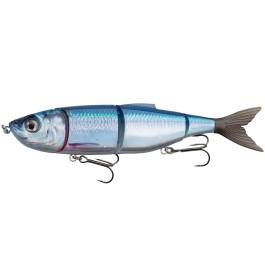
Photos: Savage Gear · supplied retailer imagery
Predator lures · Jointed swimbaits · Our take
Savage Gear 4Play V2 Swim & Jerk
Swim & Jerk — 13.5cm, 16.5cm and 20cm
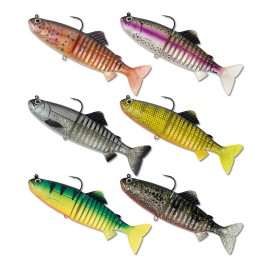
A jointed, slow-sinking baitfish imitation that swims on a steady wind and glides when you break the rhythm. Cracking for working shallow predator water, provided you pick the size your tackle can comfortably handle.
- Three sizes: 13.5cm/20g, 16.5cm/35g and 20cm/65g.
- Four articulated body parts connected by three joints.
- Hard ABS body with a semi-soft PVC tail and photo-chrome finish.
- Slow-sinking, with an S-curve swim and side glide on stop-and-go retrieves.
Make sure it’s the right one. This is the slow-sinking 4Play V2 Swim & Jerk, with a four-part articulated body and semi-soft tail. Sizes, weights and hook sizes below are kept separate.
Tackle Index Score
Tackle Index score
A well-conceived shallow-water predator lure with useful retrieve options; its appeal drops when thick weed or deep-water work dominates your fishing.
- Product Quality9/10
- Performance9.1/10
- Impact on Fish Catching8.6/10
- Ease of Use8.8/10
- Value for Money8.4/10
If you buy through our links, we might get a small kickback, but it won’t cost you a penny extra. As an Amazon Associate I earn from qualifying purchases. The full story
Who it suits
Is it right for you?
Great for
- Pike anglers covering shallow features. The shallow-running swim suits reed edges, shelves and clear water above submerged weed.
- Anglers who like varying a retrieve. You can switch between a steady S-curve swim and stop-and-go glides without changing lure.
Maybe skip if
- Anglers fishing thick weed or tangled cover. The exposed trebles are much less forgiving than a suitably rigged weedless softbait.
- Anglers mainly searching deep water. Its slow sink and shallow running character make deeper presentations slower and less direct.
The lowdown
Introducing the Savage Gear 4Play V2 Swim & Jerk
A jointed, slow-sinking baitfish imitation that swims on a steady wind and glides when you break the rhythm. Cracking for working shallow predator water, provided you pick the size your tackle can comfortably handle.
- Three sizes: 13.5cm/20g, 16.5cm/35g and 20cm/65g.
- Four articulated body parts connected by three joints.
- Hard ABS body with a semi-soft PVC tail and photo-chrome finish.
- Slow-sinking, with an S-curve swim and side glide on stop-and-go retrieves.
Quick verdict
An easy swim, with room to get creative
The 4Play V2 Swim & Jerk makes plenty of sense for pike fishing over shallow shelves, beside reed edges and above submerged weed. You get an S-curve swim from a steady retrieve, then a sideways glide when you add stops and starts. No need to spend every cast thrashing the rod about.
The catch? Those exposed trebles want reasonably clear water, and the 65g version needs tackle chosen for the job. Pick the right size and it’s a versatile shallow-water option, rather than a lure you buy expecting it to cover every depth.
A well-conceived shallow-water predator lure with useful retrieve options; its appeal drops when thick weed or deep-water work dominates your fishing.
- Product Quality
- 9/10
- Performance
- 9.1/10
- Impact on Fish Catching
- 8.6/10
- Ease of Use
- 8.8/10
- Value for Money
- 8.4/10
The articulated ABS body, semi-soft tail and detailed finish make a thoughtfully equipped package.
The S-curve swim and stop-and-go glide offer useful variety within its shallow-water role.
Changing the rhythm around ambush features gives you presentation options, though location and depth still matter more.
A steady retrieve is straightforward, with pause length and weed clearance requiring a little judgement.
Its mix of swimming and gliding presentations adds versatility, provided shallow predator fishing is a regular part of your sessions.
Head to head
How it stacks up
Side by side with the closest kit we've reviewed. This updates as we add more reviews.
Savage Gear
Savage Gear 4Play V2 Swim & Jerk (this one)
Top scorer
Scores are our own, out of 10. Best in each row is in green. Prices change, so check the latest before you buy.
The full rundown
Everything you'll want to know about the Savage Gear 4Play V2 Swim & Jerk
The Savage Gear 4Play V2 Swim & Jerk is for those swims where you want a baitfish-shaped lure working across a shallow shelf, along a reed line or over weed without charging straight down into it. It’s a jointed hard lure with a slow sink, an S-shaped swimming action and a sideways glide when you interrupt the retrieve. That gives you a useful starting point: wind it steadily to search, then change the rhythm when you reach somewhere that looks properly pikey.
The body is split into four articulated parts, connected by three joints. Most of it is hard ABS plastic, with a semi-soft PVC tail finishing things off. Its shape comes from a 3D scan of a real herring, backed up by a photo-chrome colour finish. Nice details, certainly, but don’t get too hung up on the pretty paintwork, mate. The practical attraction is the combination of a recognisable baitfish profile and a body that bends through the swim instead of moving as one rigid lump.
Size choice matters here because these aren’t three near-identical weights wearing different labels. The 13.5cm version weighs 20g, the 16.5cm steps up to 35g and the 20cm comes in at 65g. That’s a proper jump across the range. Check your rod’s casting range before choosing, rather than buying the biggest one because you fancy a PB. The smaller model gives you a more compact presentation; the largest puts a much bigger baitfish outline in front of a predator. Neither choice guarantees a better fish.
This is predominantly a shallow-water proposition. The listed running depth is 1–3ft for the 13.5cm and 16.5cm models, and 1–4ft for the 20cm. Treat those as guidance, not an invisible track the lure must follow. Retrieve speed, rod position, your trace and the time you let it sink all affect where it travels. Before launching it across a promising swim, watch a short retrieve in clear water beside you. Seeing how your particular setup behaves is dead handy when you’re trying to skim above weed.
Start simple with the retrieve. A steady wind gives the articulated body the chance to show its S-curve swim, so you don’t need a complicated jerkbait routine just to get going. Once you’ve got that rhythm, add a brief stop or a gentle change of pace. The stop-and-go action introduces a sideways glide and breaks up that regular swimming pattern. Leave yourself enough contact to notice a take, though. Feeding out a great loop of slack makes it harder to tell whether something has actually grabbed it.
The important bit about the pause is that this lure sinks slowly; it doesn’t suspend in place. That can help you change the presentation around a feature, but it also means every extra moment gives the hooks more chance to find weed or branches below. Over a clean shelf, you’ve got room to experiment. Above a scruffy weedbed, keep the stops shorter until you know your clearance. Casting along the outside of cover is generally a much happier plan than chucking exposed trebles straight into the thick of it.
For pike, pair it with a suitable bite-resistant trace and tackle that can comfortably cast and work your chosen weight. Have long forceps, suitable cutters, a proper net and an unhooking setup ready before you start. There are two trebles to manage, which matters once a lively fish is in the net. The larger version also asks more of your outfit through repeated casting. A rod that feels comfortable with the 20g lure shouldn’t automatically be expected to chuck the 65g model about all afternoon.
Who’s likely to be chuffed with it? Someone who enjoys walking a bank, covering shallow features and changing the retrieve rather than swapping lures every few casts. It offers a straightforward swim with a bit of extra control when you want to tease a likely ambush spot. It’s less convincing as your only lure for deep pits, heavy weed or every awkward corner of a canal. Buy it for that shallow swimming-and-gliding role, choose the weight sensibly, and the appeal is pretty clear. Useful movement without loads of faff.
Specifications
The nuts and bolts
- Construction
- Four-part hard ABS body, three joints and semi-soft PVC tail
- Shape and finish
- Shape based on a 3D scan of a real herring; photo-chrome colour finish
- Action
- Slow-sinking; S-curve swimming action with side glide on stop-and-go retrieves
- 13.5cm version
- 20g; two size #4 trebles; listed running depth 1–3ft
- 16.5cm version
- 35g; two size #2 trebles; listed running depth 1–3ft
- 20cm version
- 65g; two size #1 trebles; listed running depth 1–4ft
Specs checked with Savage Gear, Oct 2026.
Spot a model or spec change?
Our take
Let the pause do some work
Think of this as a swimming lure you can interrupt, rather than a jerkbait that demands constant sharp pulls. Establish a steady swim, break the rhythm and leave it room to glide.
It sinks slowly rather than hanging motionless. That’s useful for varying your presentation, but a long pause above weed can put the trebles straight into trouble.
Build and movement
Closer look: articulated rather than complicated
You’re buying a hard-bodied, jointed baitfish imitation with a softer tail, not a soft swimbait. The three joints let the four body sections work through that S-curve action. The herring-based outline and photo-chrome finish add visual detail, while the slow sink gives you scope to vary the presentation with pauses.
The hook sizes change with the lure: two #4 trebles on the 13.5cm, two #2s on the 16.5cm and two #1s on the 20cm. Keep the points checked, especially after contact with stones or submerged timber. If you replace hooks, aim to preserve the original balance rather than fitting heavier hardware without checking what it does to the swim.
Worth knowing. Slow-sinking doesn’t mean suspending. Check the lure beside the bank with your actual trace attached, then judge your pauses around the clearance you’ve got. A lovely glide is no use if it finishes with both trebles buried in weed.
Picking your water
Who it suits: shallow-water rovers and retrieve tinkerers
This makes sense for pike anglers moving between reed lines, shallow bays and defined shelves. You can search with a steady retrieve, then add stops where a clear lane crosses a likely holding area. It’s an approachable way into jointed swimbaits because basic winding already gives you a useful action.
Choose the size around both your tackle and the presentation you want. The 20g version is the least demanding casting load in this range, while the 65g model belongs on an outfit comfortable with heavier lures. Don’t mistake a bigger profile for an automatic big-pike filter; smaller fish can still have a proper go.
If most of your fishing involves punching through weed or quickly reaching deep holding water, look elsewhere first. A suitable weedless softbait or a more direct deep-water presentation tackles those jobs with less faff. The 4Play earns its place through its shallow swim and glide, not through pretending to be an all-round answer.
Bank-side questions
FAQs in full: size, pauses and working the lure
Which size should you buy? Start with the casting weight your outfit comfortably handles, then consider prey size and the profile you want. The choices are 13.5cm/20g, 16.5cm/35g and 20cm/65g. The middle model gives an intermediate option, but there’s no universal best size for every venue or day.
Will it hold its depth on the pause? No, it slowly sinks. Longer pauses let it drop farther, and your trace can influence its balance and movement. Keep that in mind when working over weed, especially when you can’t see exactly how high the weed tops reach.
Does it need constant jerking? Not at all. Begin with a steady wind and use occasional stops or gentle inputs to alter the action. Watch it close in to find a rhythm that lets it swim and glide cleanly. More aggressive rod work isn’t automatically more effective, and a simple retrieve is easier to repeat accurately along a feature.
On paper
Pros & cons
What we like
- Steady winding and stop-and-go retrieves give you different presentations from one lure.
- Three sizes let you match the baitfish profile and your outfit.
- Shallow running depths suit shelves, reed edges and clear lanes above weed.
- Articulated body and herring-based shape give it a convincing baitfish outline.
Worth knowing
- Exposed trebles make thick weed and snaggy cover awkward.
- Not the natural choice for quickly searching deep water.
- The 20cm, 65g version is too much for many lighter spinning outfits.
Want one?
Add it to your Wanted list or join a Group Buy — shops see anonymous totals only.
Your questions answered
What anglers want to know
The stuff you’d ask your mate on the next peg. Straight answers, no waffle.
01Which size should I choose?
Which size should I choose?
Match the weight to your rod first: 13.5cm weighs 20g, 16.5cm weighs 35g and 20cm weighs 65g. Then choose the profile to suit the prey fish and water you’re covering. Bigger isn’t automatically better.
02Does it suspend when you stop winding?
Does it suspend when you stop winding?
No. It’s slow-sinking, so it drops during a pause rather than staying at a fixed depth. Watch the clearance above weed and snags.
03Do I need to jerk it constantly?
Do I need to jerk it constantly?
No. A steady retrieve produces its S-curve swim. Stops, starts and gentle rod inputs let you vary that movement and bring in the sideways glide.
What anglers say
The word from the bank
Our read: an easy swim, with room to get creative. The strongest reasons to choose it are steady winding and stop-and-go retrieves give you different presentations from one lure. and three sizes let you match the baitfish profile and your outfit.; the main trade-off is exposed trebles make thick weed and snaggy cover awkward..
Our take on the feedback
Why it appeals
Checked Sept '26 — “Steady winding and stop-and-go retrieves give you different presentations from one lure.”
Best fit
Checked Sept '26 — “Pike anglers covering shallow features: The shallow-running swim suits reed edges, shelves and clear water above submerged weed.”
Worth knowing
Checked Sept '26 — “Exposed trebles make thick weed and snaggy cover awkward.”
Tackle Index’s take from the product details and fishing fit we checked. We haven’t found enough independent public feedback to call this an angler consensus yet.
Angler score
What our readers rate Savage Gear 4Play V2 Swim & Jerk
No angler score yet — nobody's reviewed Savage Gear 4Play V2 Swim & Jerk here. Be the first and get the score started.
Owner reports
Own this? Help the next angler.
Quick multiple-choice reports from people who say they own the Savage Gear 4Play V2 Swim & Jerk. Not verified purchases, and kept separate from our score.
No owner reports yet.
Alternatives & go-withs