Photos: Drennan · supplied retailer imagery
Hooklinks · Fluorocarbon · Our take
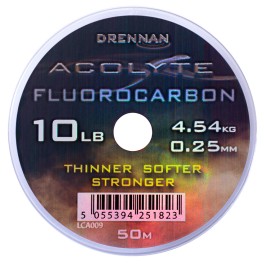
Drennan Acolyte Fluorocarbon
50m spools; 2lb–12lb options covered here
Pure fluorocarbon, 50m spools and a useful spread of diameters. Acolyte gives you plenty of scope for fine coarse-fishing hooklengths, but choosing the right thickness matters more than chasing the lightest label.
- Made from 100% pure fluorocarbon.
- Supplied on 50m spools.
- Listed options span 2lb at 0.10mm to 12lb at 0.28mm.
- Hooklink material for tying your own hooklengths rather than ready-tied rigs.
Make sure it’s the right one. This is Drennan Acolyte 100% pure fluorocarbon hooklink material. We haven't tested it on the bank; this review covers its confirmed features and likely uses.
Tackle Index Score
Tackle Index score
Provisional desk-based scores, not bank-test results; handling and durability remain unverified, and value depends on the price you find.
- Product Quality8.6/10
- Performance8.4/10
- Impact on Fish Catching7.7/10
- Ease of Use8.3/10
- Value for Money7.7/10
If you buy through our links, we might get a small kickback, but it won’t cost you a penny extra. As an Amazon Associate I earn from qualifying purchases. The full story
Who it suits
Is it right for you?
Great for
- Coarse anglers who tie their own hooklengths. The diameter range lets you build several presentation options rather than force one spool to cover every swim.
- Anglers exploring fluorocarbon for clear-water fishing. It offers a less conspicuous material option, provided you still get feeding, depth and bait presentation right.
Maybe skip if
- Anglers wanting ready-to-use convenience. You'll need to tie, check and store your own hooklengths.
- Carp anglers looking for a universal snag-fishing hooklink. These options shouldn't be treated as automatic substitutes for dedicated heavy-duty carp hooklink materials.
The lowdown
Introducing the Drennan Acolyte Fluorocarbon
Pure fluorocarbon, 50m spools and a useful spread of diameters. Acolyte gives you plenty of scope for fine coarse-fishing hooklengths, but choosing the right thickness matters more than chasing the lightest label.
- Made from 100% pure fluorocarbon.
- Supplied on 50m spools.
- Listed options span 2lb at 0.10mm to 12lb at 0.28mm.
- Hooklink material for tying your own hooklengths rather than ready-tied rigs.
Quick verdict
A useful option, not a magic fix
Acolyte Fluorocarbon makes sense if you want a dedicated hooklength material for thoughtful coarse-fishing presentations. The range runs from fine silverfish options to thicker material for more demanding work, with 50m on each spool.
Buy it for the presentation you need, not because fluorocarbon supposedly disappears underwater. Match the diameter to your hooks, tackle and swim, tie carefully, and don't expect a change of material alone to turn a blank into a bag-up.
Provisional desk-based scores, not bank-test results; handling and durability remain unverified, and value depends on the price you find.
- Product Quality
- 8.6/10
- Performance
- 8.4/10
- Impact on Fish Catching
- 7.7/10
- Ease of Use
- 8.3/10
- Value for Money
- 7.7/10
The confirmed pure-fluorocarbon construction is a sound starting point, though consistency and durability haven't been checked hands-on.
The diameter range supports varied presentations, but actual knot performance and handling remain untested.
It may help refine a suitable presentation, but there's no basis for promising extra bites over a well-chosen alternative.
Clear diameter choices simplify selection, although tying fine fluorocarbon neatly still needs care.
The 50m format offers useful hooklength-tying capacity, but without a confirmed price this is only a provisional value judgement.
Head to head
How it stacks up
Side by side with the closest kit we've reviewed. This updates as we add more reviews.
Drennan
Drennan Acolyte Fluorocarbon (this one)
Top scorer
Top scorer
Scores are our own, out of 10. Best in each row is in green. Prices change, so check the latest before you buy.
The full rundown
Everything you'll want to know about the Drennan Acolyte Fluorocarbon
Hooklength material isn't the glamorous bit of the tackle bag, is it? Nobody's leaning across the next peg to admire your spool. Yet it's right where the important stuff happens: between the rest of your rig and the bait you're asking a fish to eat. Drennan Acolyte Fluorocarbon is a straightforward option for that job. It's 100% pure fluorocarbon, supplied on 50m spools, with a spread of breaking strains and diameters. No ready-tied shortcuts here. You choose the material and build the hooklength to suit your fishing.
Let's get the honesty bit out of the way. We haven't fished with this exact line, so there are no tales of bagging up, surprise doubles or a knot that survived absolutely everything. What we can do is look at what you're buying and where it makes sense. The confirmed details give you a useful starting point, especially those diameter figures. Actual knot strength, handling and resistance to wear need proper hands-on checking. A familiar name on the spool doesn't make those things safe to assume.
The finer end starts at 2lb and 0.10mm, with 2.5lb at 0.12mm and 3lb at 0.14mm also available. That's the territory to consider when you're balancing small hooks, modest baits and careful silverfish tactics. Think about a clear swim where you're trying to keep the business end unobtrusive, rather than hauling fish away from cover. Going fine still needs a reason, though. If better feeding or a depth adjustment sorts the bites, there's no need to strip away your landing margin just for the sake of it.
Move up through the range and you've got more choices for different demands, rather than one obvious all-round winner. The 4lb version is 0.16mm, 6lb is 0.19mm and 8lb is 0.23mm, for example. Those differences matter when you match a hooklength to a feeder setup or float rig. You're balancing how the bait behaves against the pressure you'll need when a decent fish turns up. A forgiving rod or suitable pole elastic helps that balance, but neither turns a light hooklength into something you can bully fish with.
Why consider fluorocarbon at all? As a material, it's denser than nylon and has optical properties that can make it less conspicuous underwater. That's useful background, not a promise that your hooklength becomes invisible. Light, water clarity, diameter and the way the line sits all matter. It's also generally less supple than comparable nylon, which can help some presentations and work against others. If you're trying to get a tiny bait falling as freely as possible, don't assume fluorocarbon wins that contest before you've compared how your rig behaves.
The 50m spool is a practical format for tying hooklengths at home, where you've got decent light and aren't chasing a hook packet round a windy platform. Get a few sensible lengths sorted, label them properly and keep the different diameters separate. That's dead handy when you want to change one thing during a session rather than rebuild everything. You'll use some material in knots and trimming, so don't divide fifty metres by your finished hooklength length and expect an exact count. Leave yourself enough working line to tie neatly.
Knots deserve a bit of patience, particularly at the fine end. Use a knot suited to your hook or connection, lubricate it and draw it down smoothly instead of yanking it tight. Check that it has seated cleanly, then give the finished hooklength a controlled pull before it goes in the box. On the bank, inspect it after contact with anything rough or a difficult unhooking. A damaged section isn't worth nursing through another cast. Replacing it is a small faff compared with losing a fish you should have landed.
So, who should have a look? Mainly coarse anglers who tie their own hooklengths and want fluorocarbon among their options, not as a cure for every quiet spell. The heavier choices extend to 12lb at 0.28mm, but that doesn't make the range a universal answer for heavy carp work or snaggy margins. Pick for the swim in front of you. If Acolyte gives you the diameter and material behaviour your presentation needs, it's a sensible contender. If a softer nylon already does the job, there's no need to change just for the label.
Specifications
The nuts and bolts
- Material
- 100% pure fluorocarbon
- Spool length
- 50m
- Fine options
- 2lb / 0.10mm; 2.5lb / 0.12mm; 3lb / 0.14mm
- Middle options
- 4lb / 0.16mm; 5lb / 0.17mm; 6lb / 0.19mm
- Heavier options
- 7lb / 0.21mm; 8lb / 0.23mm
- Heaviest options covered
- 10lb / 0.25mm; 12lb / 0.28mm
Specs checked with Drennan, Oct 2026.
Spot a model or spec change?
Our take
Start with diameter, not just pounds
The useful choice here is between genuinely different hooklength thicknesses. A 0.10mm option and a 0.28mm option aren't interchangeable simply because both say Acolyte on the spool.
Think about bait movement, hook size and the pressure needed to land fish. Then choose the breaking strain that fits the whole setup.
What you're buying
Closer look: useful choice without the rig-box clutter
You're buying loose hooklink material on a 50m spool, so hooks, loops and finished lengths are down to you. That's useful if shop-bought hooklengths never quite match your preferred combination. You can keep the same hook and length while changing diameter, which makes adjustments on the bank easier to follow.
Pure fluorocarbon describes the material, not a guarantee of superior performance in every rig. Compared with nylon, its general density and stiffness can change how a hooklength settles and how the bait moves. We haven't checked Acolyte's specific suppleness, knot strength or wear resistance, so there's no claim here that it beats a particular rival.
Worth knowing. A spool's breaking strain isn't a promise that every finished knot will hold that load. Knot choice, tying and damage all matter. Check each finished hooklength rather than trusting the label alone.
Choose for your swim
Who it suits: anglers who like to fine-tune
If you enjoy preparing a hooklength box for float, pole or feeder sessions, there's a useful range to work with. Start with the diameters you actually need, rather than buying the lot. A couple of well-chosen options is more useful than a pocketful of spools you can barely tell apart.
For cautious fish in clear water, fluorocarbon is a reasonable presentation option to explore. Keep expectations sensible: feeding accuracy, hookbait movement and getting the depth right can matter far more. Change one part of the setup at a time if you want to understand what's making the difference.
It's less convincing as a blind purchase for heavy carp fishing or dragging fish away from snags. Choose tackle that lets you land fish safely in that swim. Equally, if a soft nylon hooklength gives your bait exactly the movement you want, sticking with it is perfectly sensible. No tackle envy required, mate.
The practical bits
FAQs in full: material, spool length and sizing
Is it pure fluorocarbon? Yes, Acolyte Fluorocarbon is 100% pure fluorocarbon rather than coated nylon. It still remains visible in some underwater conditions, so don't build your whole approach around the idea that fish can't see it.
How much do you get? Each spool holds 50m. Short coarse-fishing hooklengths will let that stretch across plenty of tying, while longer feeder hooklengths use it faster. Allow for knots, trimming and the odd one you sensibly reject because it hasn't seated properly.
Which size should you buy? Work backwards from the fish and the swim, then consider hook size, bait and tackle balance. The listed choices run from 2lb/0.10mm to 12lb/0.28mm. Don't take a fine open-water setup into snaggy margins unchanged simply because it presented a maggot nicely on your last session.
On paper
Pros & cons
What we like
- Broad diameter choice for different coarse-fishing presentations.
- Pure fluorocarbon rather than fluorocarbon-coated nylon.
- 50m gives useful scope for building a hooklength box.
- Clearly matched breaking strains and diameters make selection easier.
Worth knowing
- Fluorocarbon isn't automatically the best choice for very soft, freely moving presentations.
- Fine diameters leave less room for damaged knots or rough handling.
- No material swap can compensate for unsuitable tackle around snags.
Want one?
Add it to your Wanted list or join a Group Buy — shops see anonymous totals only.
Your questions answered
What anglers want to know
The stuff you’d ask your mate on the next peg. Straight answers, no waffle.
01Is Acolyte Fluorocarbon pure fluorocarbon or coated nylon?
Is Acolyte Fluorocarbon pure fluorocarbon or coated nylon?
It's 100% pure fluorocarbon, not nylon with a fluorocarbon coating.
02How much line is on a spool?
How much line is on a spool?
Each spool contains 50m. How many hooklengths you get depends on their length and the material used in tying.
03Which breaking strain should I choose?
Which breaking strain should I choose?
Choose by diameter as well as breaking strain, taking account of hook size, fish, snags and your rod or elastic. The listed range runs from 2lb at 0.10mm to 12lb at 0.28mm; the thinnest option isn't automatically the best.
What anglers say
The word from the bank
Our read: a useful option, not a magic fix. The strongest reasons to choose it are broad diameter choice for different coarse-fishing presentations. and pure fluorocarbon rather than fluorocarbon-coated nylon.; the main trade-off is fluorocarbon isn't automatically the best choice for very soft, freely moving presentations..
Our take on the feedback
Why it appeals
Checked Sept '26 — “Broad diameter choice for different coarse-fishing presentations.”
Best fit
Checked Sept '26 — “Coarse anglers who tie their own hooklengths: The diameter range lets you build several presentation options rather than force one spool to cover every swim.”
Worth knowing
Checked Sept '26 — “Fluorocarbon isn't automatically the best choice for very soft, freely moving presentations.”
Tackle Index’s take from the product details and fishing fit we checked. We haven’t found enough independent public feedback to call this an angler consensus yet.
Angler score
What our readers rate Drennan Acolyte Fluorocarbon
No angler score yet — nobody's reviewed Drennan Acolyte Fluorocarbon here. Be the first and get the score started.
Owner reports
Own this? Help the next angler.
Quick multiple-choice reports from people who say they own the Drennan Acolyte Fluorocarbon. Not verified purchases, and kept separate from our score.
No owner reports yet.
Alternatives & go-withs